

Let’s talk about the stat that no one wants to put in their Instagram bio: 72% of entrepreneurs report burnout. Nearly half grapple with a loneliness so profound it threatens to kill their business. It turns out the biggest threat to your solo venture isn’t the competition, the algorithm, or the economy; it’s the six inches between your own ears.
We’ve been sold the lie of the ‘hustle harder’ grind. We’ve been told that pulling all-nighters is a badge of honor. But the data is clear: solopreneurs often work fewer hours than other business owners yet suffer higher levels of stress. The game isn’t won with more hours; it’s won with a better operating system for your mind.
This isn’t another article about “positive thinking” or “good vibes only.” This is a practical, no-BS guide to forging an unbreakable solopreneur mindset. We’re decoding the 5 non-negotiable mental frameworks that separate the thriving from the burned-out. It’s time to stop just grinding and start building an internal fortress.
The Stoic Operator: Your Shield Against Chaos
Solopreneurship is a hurricane of uncertainty. A client disappears. A platform changes its rules overnight. A launch flops. Your income vanishes for a month. Panic is easy. Despair is a default. But the Stoic Operator has a different setting.
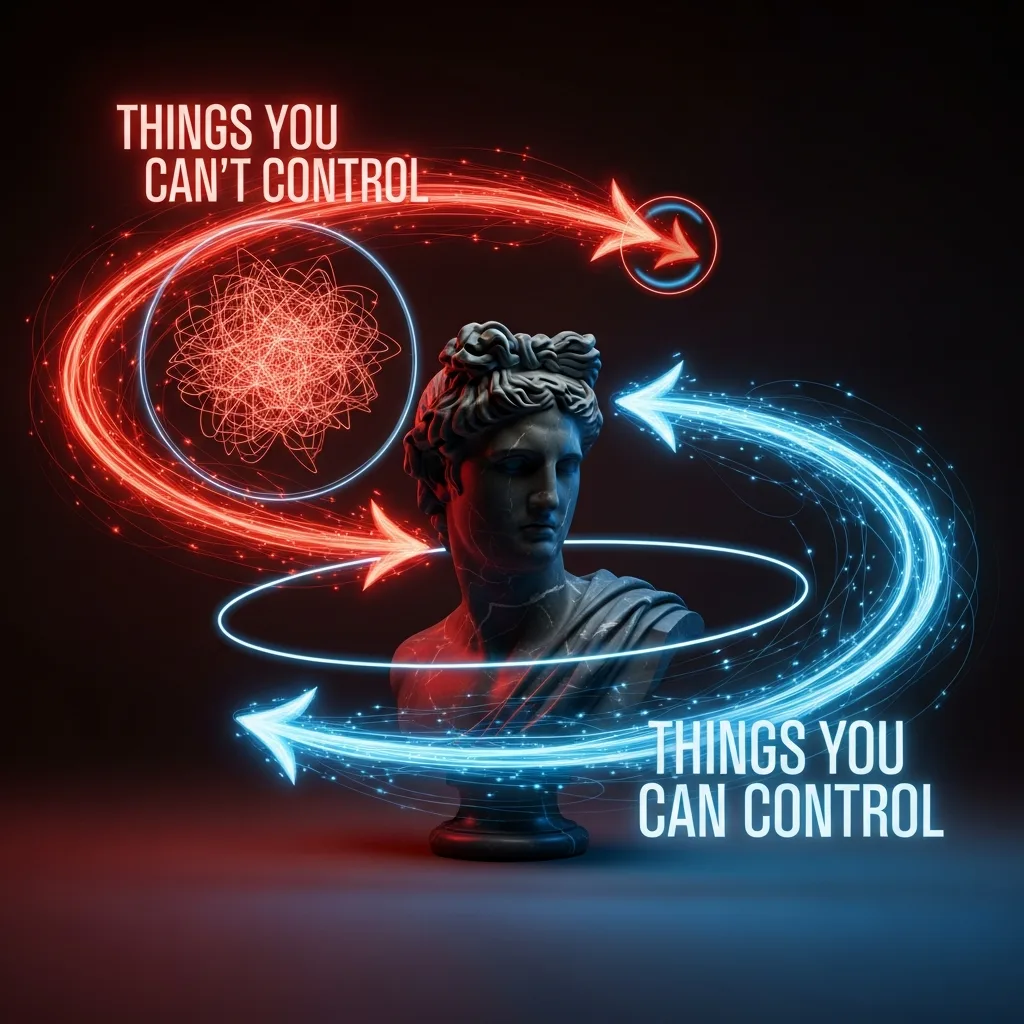
This isn’t about being emotionless; it’s about being a weapon of logic in the face of chaos. Stoicism, the ancient philosophy of Roman emperors and generals, is the solopreneur’s modern-day superpower. The core concept is brutally simple: divide everything in your life into two columns—things you can control, and things you can’t. Then, focus 100% of your energy on the first column.
The #1 reason 82% of businesses fail is cited as poor cash flow. Financial stress is the boogeyman under every solopreneur’s bed. A slow sales month is an external event you can’t directly control. A Stoic doesn’t waste energy panicking about it. Instead, they shift their entire focus to what they can control: making 10 more cold calls, sending 50 more emails, testing a new ad creative, or following up with three past clients.
This mindset transforms the battlefield. As the philosopher and trader Nassim Taleb wrote, a Stoic “transforms fear into prudence, pain into information, mistakes into initiation, and desire into undertaking.” An obstacle isn’t a roadblock; it’s a sharpening stone. A client from hell isn’t a curse; it’s a paid lesson in setting better boundaries. This is the OS that keeps you sane and moving forward when everything is on fire.
The Disciplined Creator: Forging Freedom Through Structure
Here’s one of the biggest paradoxes of the creative life: freedom is a product of discipline. We become solopreneurs because we crave freedom—freedom from bosses, from schedules, from corporate nonsense. But we often resist the very thing that will guarantee that freedom: structure.
Startups are born from a creative spark, but they grow through discipline. Your brilliant idea is the kindling, but disciplined systems are the logs that keep the fire burning through the winter. The mindset for business owners who succeed is one that evolves from “artist” to “architect.”
Think of your creativity as a powerful river. Without banks, it’s a useless, destructive flood, spreading wide but having no impact. Discipline builds the banks. It channels that creative energy, giving it the focus and force to carve canyons. Discipline is not the enemy of creativity; it’s the channel that makes it profitable.
It’s the discipline to show up on the days you’re not inspired. The discipline to track your numbers even when they’re scary. The discipline to create a content calendar and stick to it. The discipline to build standard operating procedures (SOPs) for the boring stuff so you can free up mental RAM for the genius stuff. Discipline isn’t your prison; it’s the blueprint for your escape.
The Curious Scientist: Treating Failure as Data, Not a Verdict
Let’s talk about failure. The word itself feels heavy, final. But the successful entrepreneur mindset doesn’t even acknowledge it. Instead, it sees only one thing: data.

A software engineer on Reddit shared his story. He spent months building his first product, launched it, and made a painful $27. He described it as an “emotional rollercoaster” that made him want to quit forever. But then, he made a crucial mental shift. He chose to see that $27 not as a verdict on his worth, but as validation. It was proof that he, a guy with a 9-to-5, could make money online. It was a signal. He took the data from that “failure”—what he learned about marketing, SEO, and his audience—and poured it into his next idea. That second product made $700 in its first week.
This is the game. It’s not about being right the first time. It’s about increasing your rate of experimentation. Indie hacker Pieter Levels, famous for creating Nomad List, launched over 70 projects to find his big winners. Nathan Barry, founder of the email giant ConvertKit, failed with 10 different products before he struck gold.
They weren’t failing; they were testing. They were running experiments and gathering data. Every failed launch, every rejected proposal, every ad that doesn’t convert is just tuition you pay for an invaluable lesson. The goal isn’t to avoid failure. The goal is to get the data as quickly and cheaply as possible so you can pivot to what actually works.
The Courageous Contrarian: Winning the War With Yourself
The journey of a solopreneur is intensely internal. You have to be willing to fight—and win—the war with your own demons.
First, there’s the loneliness. That feeling of isolation isn’t just a mood; it’s a business liability. A 2023 study confirmed that chronic loneliness leads to decreased passion and a significantly higher intention to quit. The courageous move is to treat your mental state as a core business function. It means proactively building a support network—masterminds, mentors, fellow hustlers—before you’re in a crisis.
Second, there’s the “I can do it all” ego trap. Forbes identifies this as a primary reason for failure. Being a solopreneur doesn’t mean you have to be the CEO, the marketer, the accountant, and the janitor. The courageous mindset knows when to delegate. It’s hiring a freelance bookkeeper or using AI tools to handle tasks outside your zone of genius so you can focus on what only you can do.
Finally, there’s the most dangerous trap of all: overconfidence. A wild 2024 study found that major positive life events—getting married, having a baby—can be more dangerous to a business than negative ones. Why? They create an “overconfidence trap,” leading founders to make lazy, gut-based decisions instead of rigorous, data-driven ones. The courageous contrarian is vigilant, questioning their own assumptions even when things are going great. This is how to think like a solopreneur who is playing the long game.
The Unbreakable You
These five mindsets—the Stoic Operator, the Disciplined Creator, the Curious Scientist, and the Courageous Contrarian—are not separate personality traits. They are tools in your mental arsenal. And the fifth, most critical mindset, is the fusion of them all. It’s the meta-skill of knowing which tool to deploy at any given moment.
It’s knowing how to be the Stoic when a client ghosts you, the Disciplined Creator when you need to ship a project, the Curious Scientist when it flops, and the Courageous Contrarian when you feel the pull of ego or despair.
Being a solopreneur isn’t a job; it’s an identity. It’s a declaration that you’re willing to take full responsibility for your own life. The grind doesn’t build the business; your mindset does. It’s the foundation upon which everything else is built. Stop just working in your business and start working on the person running it. That’s the only variable you can truly control, and it’s the only one that guarantees you can’t lose.
Which of these 5 mindsets do you need to forge first? Drop a comment below. We’re all in this build together.