

You’ve got the idea. You’ve got the drive. You’re making a few sales through Instagram DMs or a cobbled-together Facebook page. But let’s be real—does it feel legit? Or does it feel like you’re one algorithm change away from being totally invisible?
Here’s a wake-up call, hustler. A recent study found that 84% of consumers believe a business with a real website is more credible than one that just lives on social media.
Read that again. Eighty-four percent.
If you don’t have a website, you don’t exist for the vast majority of your potential customers. You’re a ghost. A whisper in the digital wind.
This guide isn’t about boring tech jargon. We’re not here to put you to sleep with server specs and talk of protocols. This is your battle plan for claiming your territory online. We’re going to break down what is hosting in the simplest terms possible and show you exactly why you need hosting to stop being a hobbyist and start building a brand that lasts.
This is the foundation of your empire. Let’s get to work.
What is Hosting, REALLY? Your Digital Real Estate Deed
Forget everything you think you know about the tech behind websites. Let’s stop thinking like coders and start thinking like property investors—because that’s exactly what this is.
Imagine you want to build a physical store. What do you need first? You need an address so people can find you, and you need a piece of land to build on.
The internet works the same way. This is the digital real estate analogy, and it’s the only thing you need to understand how hosting works.
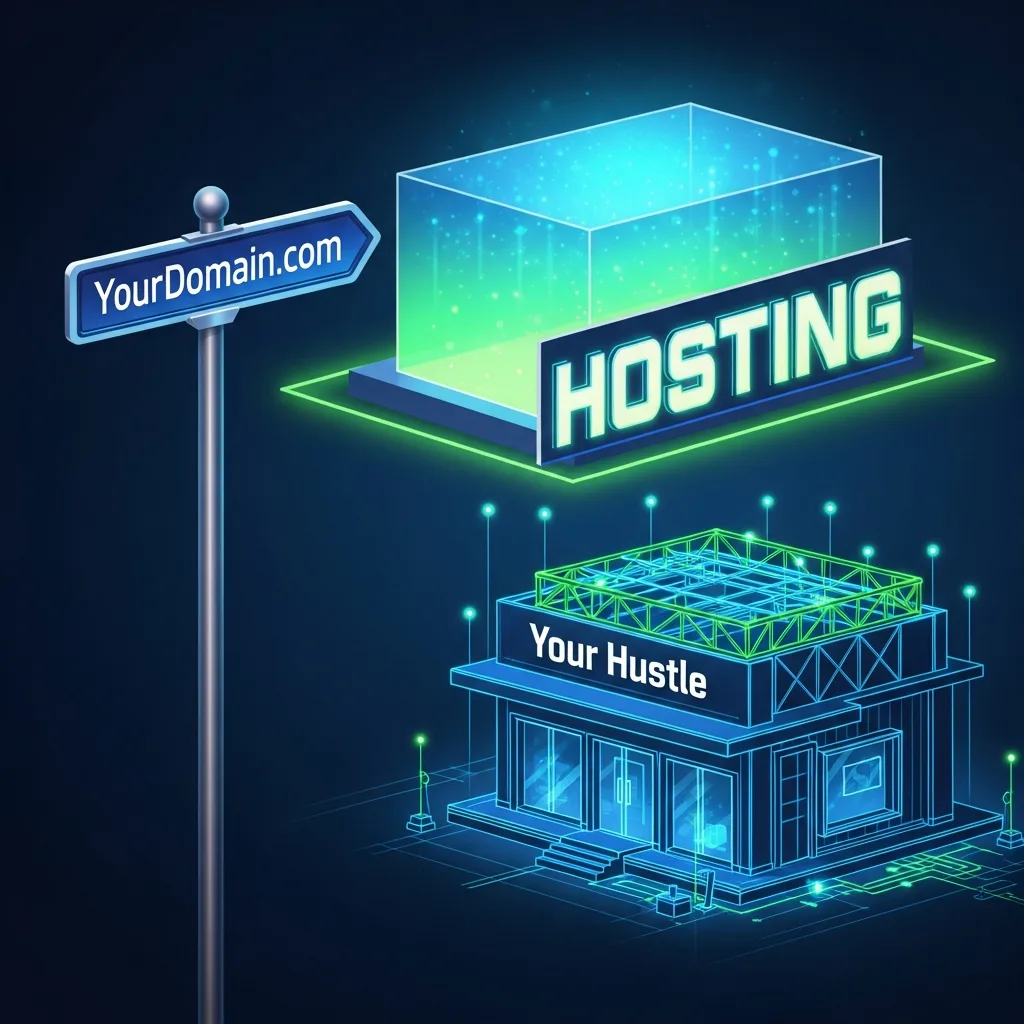
- Your Domain Name (e.g., YourBadassHustle.com): This is your unique street address. It’s the memorable, brandable name that you tell people. It’s how they find you in the vast landscape of the internet.
- Website Hosting: This is the plot of land you own at that address. It’s a physical, tangible space where you can build whatever you want. Without the land, your address just points to an empty lot.
- Your Website Files (WordPress, images, text): This is the actual house you build on your plot of land. It’s your storefront, your gallery, your office—the structure that people see and interact with when they arrive.
So, what is hosting? It’s renting a guaranteed, ready-to-build-on plot of land on a super-powerful, specialized computer (called a server) that’s connected to the internet 24/7. When someone types in your address (your domain), that server “serves up” your house (your website files) for them to see.
That’s it. That’s the big secret.
Why does this matter? Because owning your hosting is like owning your land. You have control. You’re not just decorating a temporary space or running a pop-up shop. You are building a permanent, valuable asset.
The Legitimacy Gap: Why Social Media is the Hustler’s Trap
“But I have 5,000 followers on Instagram! I get all my clients there.”
I hear you. But building your entire business on social media is like building a mansion on rented land. It looks impressive, but the landlord can change the rules, raise the rent, or kick you out at any moment—and you’re powerless to stop it.
You don’t own your followers. You can’t control the algorithm that decides who sees your posts. Your entire business can be wiped out overnight by a random policy change or a platform’s decline in popularity. Remember MySpace? Exactly.
This is the credibility factor, and it’s a gap you can’t afford to ignore. Research shows that 75% of people judge a business’s credibility based on its website design. A professional website with your own domain and hosting signals that you’re serious, trustworthy, and here to stay. It’s the difference between that frantic pop-up stand and a permanent, high-end storefront.
Your website is the central hub of your empire. Social media, email lists, and online ads are just the roads that lead people to your property. Your website is the destination where you control the entire experience. It’s where you capture leads, tell your story, and make sales on your terms.
Don’t take my word for it. A side-hustler on Reddit shared their story of hitting their first $1,000-a-month milestone. Their secret wasn’t “hustling 24/7” on social media. It was focusing on Search Engine Optimization (SEO) for their own website from day one. It took a couple of months, but it eventually turned into a passive income stream. That’s a long-term strategy that is flat-out impossible when you’re just a tenant on someone else’s platform.
The High Cost of “Free” & The Danger of Cheap
Okay, so you’re convinced. You need a website. But your budget is tight, and the allure of “free hosting” is screaming your name.
Stop right there.
“Free” hosting isn’t free. You pay for it with your brand, your reputation, and your potential.
Let’s pull back the curtain on what “free” really gets you:
- Forced Ads: The hosting company will plaster their ads all over your website, making your hustle look cheap and unprofessional.
- Unprofessional Domains: Your address won’t be
YourHustle.com. It will beyourhustle.somefreehost.com. It screams “amateur.” - Laughable Security: Free hosts have little incentive to protect you. You and your customers’ data are sitting ducks for hackers.
- SEO Suicide: Search engines like Google know these sites are low-quality. They often ignore them completely, making you invisible to search.
- Vanishing Acts: Your site could be slow, crash frequently, or disappear entirely without warning. You have no recourse.
That last point—reliability—is where we move from “unprofessional” to “catastrophic.” For small businesses, website downtime can cost between $137 and $427 per minute. But the immediate loss is nothing compared to the long-term damage. One study found that 79% of shoppers who have a bad experience on a site will never return to buy again.
One business owner shared their “wake-up call” about this. Their online store, built on cheap, unreliable hosting, kept crashing during peak traffic. Each crash was like a slammed door in a customer’s face. It was a brutal lesson on the true cost of trying to save a few bucks, forcing them to find a trustworthy provider. Only then did their sales and customer confidence begin to grow.
And it’s not just users who hate it. Google is always watching. It penalizes sites with poor uptime by burying them in search results. Choosing bad hosting isn’t just a missed opportunity; it’s an act of self-sabotage that actively works against your growth.
Choose Your First Property: Hosting for Beginners That Won’t Break the Bank
Ready to make a move? Good. Let’s find your first property. We can use our real estate analogy one last time to make this simple. This is how you find the best hosting for beginners.
- Shared Hosting: This is your first apartment. It’s incredibly affordable, it comes fully managed, and it gets you into a great building immediately. You share the building’s resources (the server) with other tenants, but it’s the perfect, low-cost way to get your business online. For 99% of side hustlers, this is the best option, period.
- VPS (Virtual Private Server) Hosting: This is like upgrading to a townhouse. You still share the same overall complex, but you have your own guaranteed space, more resources, and more control. This is the move you make when your website traffic starts getting serious and you need more power.
- Dedicated Hosting: You own the entire skyscraper. All the resources, all the control, and all the responsibility (and cost). This is for when your side hustle has exploded into a full-blown enterprise with massive traffic.
Let’s be clear: you start with Shared Hosting.
The cost is a non-negotiable business investment, just like a business license or your laptop. We’re not talking about a fortune here. A quality shared hosting plan is often less than the cost of two lattes a month. For that price, you secure your entire online brand, establish credibility, and build a real asset.

Conclusion: Your Digital Empire Awaits
Let’s recap the mission. We’ve busted the jargon and revealed what is hosting: the foundational plot of land for your online business. We’ve shown why you need hosting: to gain credibility, take control of your brand, and build a long-term asset that you truly own.
Your side hustle deserves more than a temporary, flimsy social media page. It deserves a permanent home. A professional headquarters. An asset that grows in value over time.
And here’s the final punch: just like real estate, a well-built website with traffic and a strong brand can be sold. It’s a flippable asset. You’re not just building a presence; you’re building equity.
The question is no longer if you need hosting, but when you’ll finally grab a shovel and break ground.
Stop paying rent on someone else’s platform. It’s time to claim your territory.
What’s the first brick you’re going to lay for your digital empire? Tell us in the comments below!