
Staring at that empty price box on your screen, right? Your product is ready. Your website is slick. But that blinking cursor in the pricing field feels like the final boss. It’s mocking you.
A million questions flood your brain.
- What if they laugh at my price?
- What if nobody buys a damn thing?
- What if I charge too little and look like a joke?
The fear is real. One hustler on Reddit put it perfectly: “My real worry is the community. I don’t want these people offering us less and less just because we let them lowball us.” That hits hard. It’s the fear of not just failing, but devaluing your own work and the work of others.
Let’s reframe this right now. Setting your first price isn’t a math test. It’s a declaration of value. It’s you, the hustler, planting a flag in the ground and saying, “I built this, and it’s worth something.”
As the legend Warren Buffett said, “The single most important decision in evaluating a business is pricing power.” We’re here to build that power from day one.
Forget the boring economics lectures. This is your practical, confidence-building battle plan. We’ll walk you through smart, actionable steps to pick a number, crush the fear, and land that first glorious, paying customer. This is your definitive guide on how to set your first price when you have zero sales and a whole lot of hustle.
Why Pricing Feels Impossible (And Why It’s a Good Thing)
That knot in your stomach? The one that tightens every time you think about money? It’s not a bug; it’s a feature. It means you give a damn. It means you’re obsessed with delivering real value and you’re terrified of falling short.
That fear is a signal you’re on the right track. But let’s break down why it feels so damn hard.
Price Is Your Loudest Signal
Before a customer reads your copy, sees your testimonials, or understands your features, they see your price. And they judge. In a world of infinite choice, price is often used as a stand-in for quality.
Think about it. You need a new blender. You know nothing about blenders. You see three on the shelf: one for $20, one for $90, and one for $300. Which one do you assume is the best? Which one do you assume is least likely to crap out in six months?
Exactly. The most expensive one.
Charging too little doesn’t make you the “smart choice.” It can make you look cheap, untrustworthy, and desperate. A low price screams, “I don’t even believe in my own product.”
The Imposter Syndrome Trap
Let’s be real. It feels like you’re putting a price tag on yourself. Your late nights, your skipped weekends, your raw ambition—all condensed into a single dollar amount. When you don’t have sales data or a long list of clients, that number feels personal.
You’re not selling a product; you’re selling a piece of your soul, and you’re terrified someone will say it’s only worth five bucks. This is the imposter syndrome trap. It whispers that you’re not ready, that you’re not good enough, and that you should just be grateful anyone is paying attention at all.
We’re here to tell that voice to shut the hell up.
Your Price Is Your Gatekeeper
Your goal isn’t to attract every bargain-hunter on the internet. That’s a race to the bottom you’ll never win. 54% of small businesses say their biggest challenge is finding and retaining customers. The right price is your bouncer—it filters out the tire-kickers and time-wasters.
It attracts the right customers. The ones who see the transformation you offer, not just the cost. They are less work, they value your expertise, and they become true fans. A smart pricing strategy for new business isn’t about being the cheapest; it’s about being the most valued.
So, that fear you feel? It’s a sign you’re ready to move beyond just getting by and start building something that lasts.
The Anti-MBA Guide to Basic Pricing Models
Okay, you’ll see these terms thrown around in dusty business textbooks. Most of it is fluff. We’re going to break down the only three models that matter for a hustler starting from scratch. No spreadsheets, no calculus—just the straight-up truth.
1. Cost-Plus Pricing (The “Cover Your Ass” Method)
This is the most basic model on the planet. It’s pricing for survival.
The Formula: Your Costs + Your Desired Profit = Your Price
Let’s say you sell custom-printed t-shirts. The blank shirt costs you $8. The printing costs you $10. Your shipping materials are $2. Your total cost is $20. You want to make at least $15 profit per shirt.
Your price is $20 (Costs) + $15 (Profit) = $35.
The Hustler’s Take: This is your absolute baseline. Your “don’t go broke” number. It’s a necessary calculation to make sure you’re not losing money, but it’s a terrible way to set your final price. Why? Because it has nothing to do with what the customer gets. Your costs are your problem, not theirs. Use this as your internal floor, but never let it be your ceiling.
2. Competitor-Based Pricing (The “Market Intel” Method)
This is where you scope out the competition to see what they’re charging. But listen up: this is for intelligence gathering, not for copying.
You need to understand the battlefield. What are other hustlers charging for similar services or products? What do their customers get? Are they targeting high-end corporate clients or scrappy startups?
Remember the Rolls Royce story? They sell cars at aircraft shows. Why? Because as investor Rory Sutherland points out, “If you’ve been looking at jets all afternoon, a £300,000 car is an impulse buy.”
Context frames value.
Your competitor’s price is just one data point in a much larger context. Are they the Rolls Royce or the Honda Civic of your industry? Don’t just look at their price; look at their positioning. Look at what they don’t offer. Your opportunity lives in those gaps.
3. Value-Based Pricing (The “Hustler’s North Star” Method)
This is it. This is the mindset shift that separates the amateurs from the pros. It’s the key to how to price a product for the first time with confidence.
Stop thinking about your costs. Stop obsessing over your competitors. Start thinking about your customer’s results.
What transformation do you provide?
- Do you save them 10 hours of tedious work every week? What is that time worth to them?
- Do you help them land a client worth $5,000?
- Do you give them the confidence to finally quit their job and go all-in on their dream?
That is the value. You’re not selling a piece of software; you’re selling freedom. You’re not selling a coaching session; you’re selling a breakthrough.
When you frame it this way, charging $100 for something that makes your customer $1,000 doesn’t seem expensive anymore—it seems like a steal. This isn’t about plucking a number from thin air. It’s about anchoring your price to the incredible outcome you deliver. This is your North Star.
From Zero to GO: 4 Battle-Tested Tactics to Set Your First Price
Theory is cool. Action is better. You have zero sales data. You’re standing at a dead start. How do you actually pick a number and get moving?
Forget the analysis paralysis. Here are four battle-tested tactics you can use this week to get your first paying customer and start gathering real-world data.
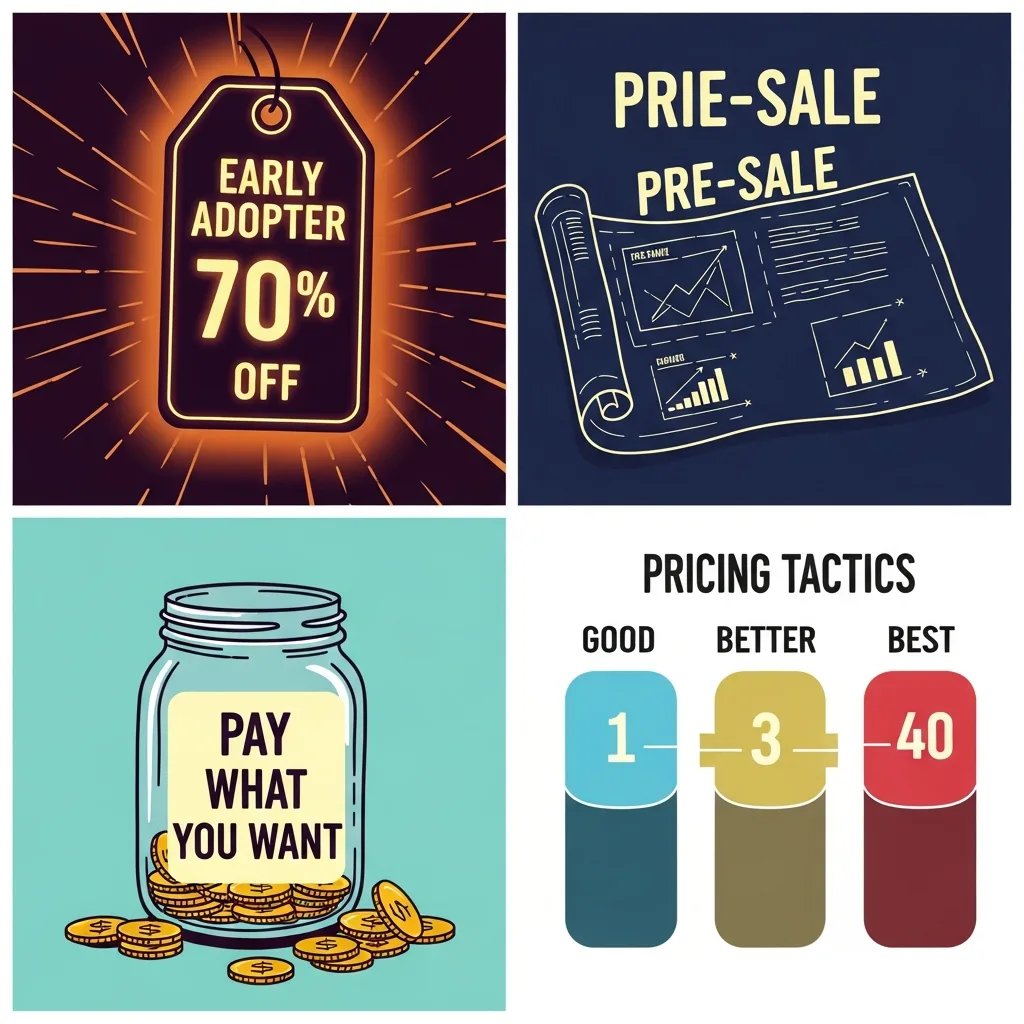
Tactic #1: The “Early Adopter” Power Play
This move is pure genius for its simplicity and power. It’s a strategy we saw work wonders for an entrepreneur on Reddit.
Instead of launching with a low “introductory” price you’ll feel stuck with, you do the opposite. You launch with your target full price, but offer a massive, highly-visible discount for your first batch of customers.
Here’s the play:
- Decide on your ideal, confident price. Let’s say it’s $99/month.
- Set that as the official price on your site. Make it big and bold: $99/month.
- Right next to it, add a can’t-miss offer: “Be one of our first 50 members! Get 70% off FOREVER. Pay just $29/month.”
Why this works:
- It anchors your value high. You’ve psychologically established that your product is worth $99.
- It creates insane urgency. The offer is limited, driving people to act NOW.
- It gives you a graceful way to raise prices. Once you hit 50 customers, you just remove the discount. The price is now $99, and no one can complain. You gave them a fair shot.
You get paying customers in the door fast while validating your long-term price from day one.
Tactic #2: The Pre-Sale Validation
Want the ultimate proof that your price is right? Ask people to pay you before you’re even finished.
This is the scariest—and most powerful—validation you can get. One founder did this by creating a simple landing page for a product he was still building. He offered lifetime access for a one-time fee of $50. In two weeks, 10 people paid him.
He didn’t just validate his idea; he validated his price.
You don’t need a finished product. You need a compelling promise. A landing page, a slide deck, a video—whatever it takes to explain the transformation you’re offering. If people will pay for the promise, you’re sitting on gold.
Tactic #3: The “Pay What You Want” (PWYW) Data Hack
Feeling completely lost? Let your customers tell you what your product is worth. For digital products, ebooks, or templates, PWYW is a brilliant market research tool and a masterclass in pricing for beginners.
One digital creator used a PWYW model for a new ebook. He eliminated the guesswork and let the market decide the value. This gave him a real-world ballpark for setting a permanent price later.
But doesn’t that mean everyone will just pay $1? Nope. Research shows that when you use a “suggested price,” around 80% of people pay it. More importantly, your true fans—the ones you want to build a tribe around—often pay more than the suggested price to show their support.
You get immediate cash flow, build an email list of die-hard supporters, and gather priceless data on your product’s perceived value.
Tactic #4: The “Good, Better, Best” Frame Game
You’ve seen this everywhere because it works. Humans are terrible at evaluating a single option in a vacuum. We need context. Tiered pricing gives us that context.
Even with no sales history, you can create three packages:
- Option 1: The Basic ($29): Good, but missing a key feature.
- Option 2: The Pro ($49): The perfect sweet spot. This is the one you want them to buy.
- Option 3: The Premium ($99): The anchor. It seems expensive, but its real job is to make the Pro tier look like an incredible deal.
This tactic shifts the customer’s mindset from “Should I buy this?” to “Which one should I buy?” You’re framing the decision in your favor and guiding them toward the best-value option.
Mind-Hack Your Price Tag: Simple Psychology for a Confidence Boost
Pricing isn’t just numbers; it’s neuroscience. Your customer’s brain is lazy and uses mental shortcuts to make decisions. You can use these psychological quirks to make your price more appealing and give yourself a jolt of confidence.
Embrace Charm Pricing (.99)
Ending your price in .99 isn’t sleazy; it’s science. It’s called Charm Pricing, and it works because of the “Left-Digit Effect.” Our brains anchor on the first number we see, so $2.99 feels psychologically much cheaper than $3.00. We read from left to right, and the “2” lodges itself in our brain before we even process the rest.
How effective is it? Studies show it can boost sales by a minimum of 24%. One study even found it increased demand by 35%. So go ahead, change that $50 to $49. It just feels better.
Shorten the Syllables
This one is wild. A 2012 study revealed that people perceive prices with more syllables as being higher, even if the number is smaller.
Let’s say your price is “$27.82”. Say it out loud: “twenty-seven eighty-two.” Seven syllables.
Now say “$28.16”: “twenty-eight sixteen.” Five syllables.
The first one feels more expensive because it takes more mental effort to process.
The takeaway? Keep your numbers clean and sharp. $1499 feels faster and cheaper than $1,499.00. Drop the comma. Drop the cents. Make it easy for the brain to say “yes.”
The Power of “Just”
Words frame value. The difference between a customer seeing your price as a cost versus an opportunity can come down to a single word.
Consider these two options:
- “The price is $20.”
- “Get started for just $20.”
The first one is a blunt transaction. A cost. The second one softens the number and frames it as a small, easy step towards a bigger reward. It’s not a barrier; it’s an accessible entry point. Sprinkle this little word into your checkout page and call to action. It’s a small change with a big impact.

Your Price is a Starting Line, Not a Finish Line
Let’s get one thing straight: pricing isn’t a one-time, high-stakes decision you have to get perfect on day one. It’s a process. It’s an experiment. It’s a conversation with your customers.
The goal is not to find the perfect price. The goal is to set your first price and get in the game.
We’ve walked through the battle plan. You know why pricing feels impossible and how to turn that fear into a strength. You understand the difference between pricing for survival (Cost-Plus) and pricing for growth (Value-Based). You have four concrete tactics—from the “Early Adopter” play to pre-selling your promise—to get you off of zero.
The real journey begins after you set that first price.
Think about the Indie Hacker who built his SaaS product. He started at a timid $5/month because he was afraid. But then he did the most important thing: he listened. His customers told him it was worth more. He found his courage and confidently raised his price to $20, then $30/month. His revenue grew, and his business transformed.
That’s the path. You start, you listen, you learn, and you iterate. Your first price is just the starting gun.
You have the tools. You have the research. It’s time to be brave.
What price are you going to test first? Drop it in the comments below—let’s speak it into existence.