
Ask ten companies if they use AI agents and you’ll get answers from “barely” to “everywhere”. One survey of large-enterprise tech leaders, Mayfield’s 2026 CXO survey, found 42% had agents in production1, while OutSystems’ 2026 report says 96% use agents in some capacity2. Same planet, wildly different scoreboards.
So what’s real, Tribe? Here’s the deal: agentic team mates are genuinely useful, and also genuinely overhyped. Both are true. This guide gives you the plain-English definition, the honest receipts (wins and faceplants), and a five-step playbook to put your first one to work without handing over the keys to your hustle. We got this.
What an “Agentic Team Mate” Actually Is (and Isn’t)
Forget the buzzwords for a minute. A chatbot answers when you ask. An agentic team mate takes a goal, plans steps, uses tools (your inbox, your spreadsheet, your CRM) and keeps going until the job is done or it needs you.
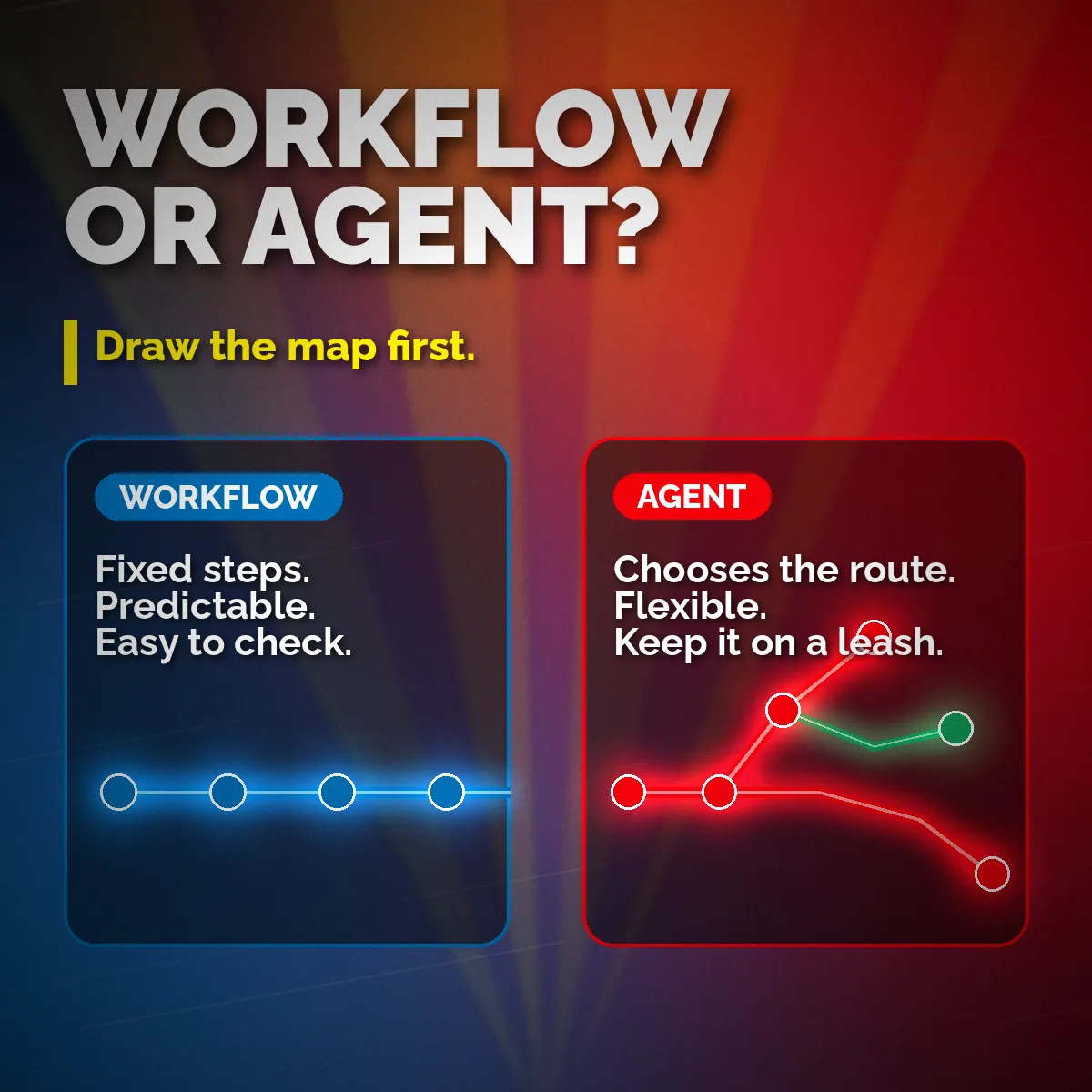
The people building this stuff draw a useful line. In its “Building effective agents” guide, Anthropic describes workflows as systems where LLMs and tools are orchestrated through predefined code paths, and agents as systems where the LLM dynamically directs its own process and tool use3. Translation:
- Workflow: you draw the map. The AI follows it. Predictable, easy to check.
- Agent: you give the destination. The AI chooses the route. Flexible, harder to predict.
Here’s the part nobody puts on the sales page. The same Anthropic guide recommends you find the simplest solution possible and only add complexity when it clearly pays off3. Curious hustlers ask, “Do I need an agent, or just a good workflow?” Smart answer: often the workflow.
And watch out for costume changes. Gartner warns about “agent washing”, where vendors rebrand existing products such as AI assistants, RPA or chatbots as agents without substantial agentic capabilities4. If the tool can’t plan, use tools and act on its own, it’s a chatbot in a new hat. Ask for a live demo on a real task before you pay for anything.
The 60-second test: workflow or agent?
Run your task through three questions before you spend a rand or a dollar:
- Can you write the steps down in advance? If yes, build a workflow. It’s cheaper, faster and easier to audit.
- Does the path change depending on what the AI finds? If yes, an agent might earn its keep, but only inside tight limits.
- What does a mistake cost? If the answer is “a little embarrassment”, you can let it run with a daily check. If the answer is “money out of my account or a note sent to a customer”, a human signs off first.
Plenty of side hustle tasks land on question one. That’s not a failure of ambition. That’s discipline.
The Hype Is Loud. The Scoreboard Is Quieter.
Let’s be Stoic about this: control what you can verify.
McKinsey’s 2025 global survey of 1,993 people found that 23% say their organisations are scaling an agentic AI system somewhere, and another 39% are experimenting5. The catch: no more than 10% report scaling agents in any single business function5. Lots of kicking tyres, not a lot of highway miles.
Why do the numbers jump around so much? Definitions. CrewAI’s 2026 survey reports 65% of organisations already use agents, yet its own authors suggest respondents may be confused about what true agentic AI is6. Halkwinds Research counts 45% of enterprise AI teams with at least one autonomous agent in production7. Same word, different yardsticks. (Heads up: several of these surveys are run by companies that sell AI tools or invest in them, so read them as signals, not gospel.)
Then there’s the results question. MIT’s Project NANDA reported that 95% of organisations see no measurable profit-and-loss return from enterprise generative AI initiatives8. Important caveat: that’s about generative AI broadly, not agents only, and the report labels itself preliminary findings, built on 52 interviews, a survey of 153 leaders and a review of about 300 public initiatives8. But the pattern lines up with Gartner’s forecast that over 40% of agentic AI projects will be cancelled by the end of 2027 because of escalating costs, unclear business value or inadequate risk controls4.
Read that again: costs, unclear value, weak controls. Not “the AI isn’t smart enough”. The failures are about management. And management is something a disciplined hustler can do.
Why Small Teams Might Have the Edge
Big companies have big budgets. They also have big meetings, big approval chains and big legacy systems. McKinsey notes that nearly half of respondents from companies with more than $5 billion in revenue have reached the AI scaling phase, versus 29% of those under $100 million5. That gap says money helps. It doesn’t say small teams can’t win.
Look at where small businesses actually are. The 2026 U.S. Chamber of Commerce small business report, a survey of 3,732 small businesses, found that 66% now use AI, up from 23% in 2023, and 24% use agentic AI tools9. It’s also cheap to start: 41% use free AI tools, and the median monthly spend among those paying is $2509. (These are U.S. numbers, self-reported. We found no South African equivalent, so treat it as UNKNOWN for our home turf.)
What are those owners saying about jobs? 47% say AI is creating jobs in their business, while 6% say it enables headcount reductions9. And AI users were at least 7 points more likely to report growth in sales, profit and workforce9. That’s a correlation, not a promise: maybe AI helps growth, maybe growing businesses adopt AI faster. Either way, you’re not late.
Here’s the Creative angle. In a Fortune interview, the lead author of the MIT NANDA report said the startups seeing the fastest revenue jumps pick one pain point, execute well, and partner smartly10. A solo hustler is built for exactly that. No committee. One pain point. Go.
One real example from the same Chamber report: a solopreneur who runs a security-guard training academy feeds state legal code into Google NotebookLM with strict guardrails so course content stays verbatim-accurate9. Notice the move: a narrow job, a trusted source, firm guardrails. Not “run my company”.
Where Agents Break (the Receipts)
Courageous means looking at the bad news too. Here’s where agentic team mates stumble.
Back-and-forth work. Salesforce AI Research built a benchmark of realistic CRM tasks called CRMArena-Pro. Leading agents managed around 58% success on single-turn tasks and approximately 35% when the task needed multi-turn interaction11. The standout? Workflow execution proved more tractable, with top agents passing over 83% in single-turn tasks11. Agents shine on the checklist and wobble when they have to ask the right questions. (The study tested 2024-25 model versions on synthetic data, so expect movement, but the lesson holds.)
Keeping secrets. The same study found agents showed near-zero inherent confidentiality awareness, and that targeted prompting can help but often compromises task performance11. Translation: never hand an agent data it doesn’t need. If it can’t see it, it can’t leak it.
Going too far, too fast. Klarna is the cautionary tale. In February 2024 the company announced that its AI assistant was handling two-thirds of customer service chats, with customers resolving errands in under two minutes instead of eleven (company-reported)12. Yet in 2025 its CEO told Bloomberg that focusing on cost had produced lower quality, and the company began recruiting humans again so customers always have someone to talk to13. Keep the AI for the routine. Keep a human for the moments that matter.
Sprawl. In OutSystems’ vendor survey, 94% of IT leaders worry that AI sprawl is increasing complexity, technical debt and security risk2, and in Mayfield’s survey 60% of enterprises report early-stage or no formal AI governance1. Ten half-managed agents are worse than two well-managed ones.
Anthropic puts the risk plainly: the autonomous nature of agents means higher costs and the potential for compounding errors, so it recommends extensive testing in sandboxed environments with appropriate guardrails3. One small mistake, repeated fast, is still a mistake. That’s why you need a playbook.
The Tribe Playbook: Hire an Agent Like You’d Hire a Human
You wouldn’t hire a stranger, hand them your bank login and disappear for a month. Treat your agentic team mate the same way. Five steps. Disciplined, simple, repeatable.
1. Pick ONE pain point. Not “automate my business”. Pick the task that eats your hours and has a clear finish line: sorting enquiries, drafting first-pass replies, formatting reports, tagging leads. The MIT NANDA report found back-office automation often yields a better return, even though around half of generative AI budgets went to sales and marketing tools8. The unglamorous job often pays first.
2. Write the job description. Goal, inputs, outputs, what “done” looks like, what it must never do. If you can’t write it in half a page, the task isn’t ready for an agent. Here’s a template you can steal:
- Job: Triage new customer enquiries each morning.
- Inputs: The shared inbox (read-only) and our FAQ document.
- Output: A table with sender, topic, urgency and a suggested reply, saved as a draft.
- Done means: Every new enquiry is sorted by 09:00 and nothing is sent without me.
- Never: Send replies, quote prices, make commitments on our behalf or open attachments.
3. Start with a workflow, upgrade to an agent only if you must. Draw the fixed steps first. Where the path truly can’t be predicted, give the agent freedom, inside limits. That’s Anthropic’s advice in action: simplest solution first3.
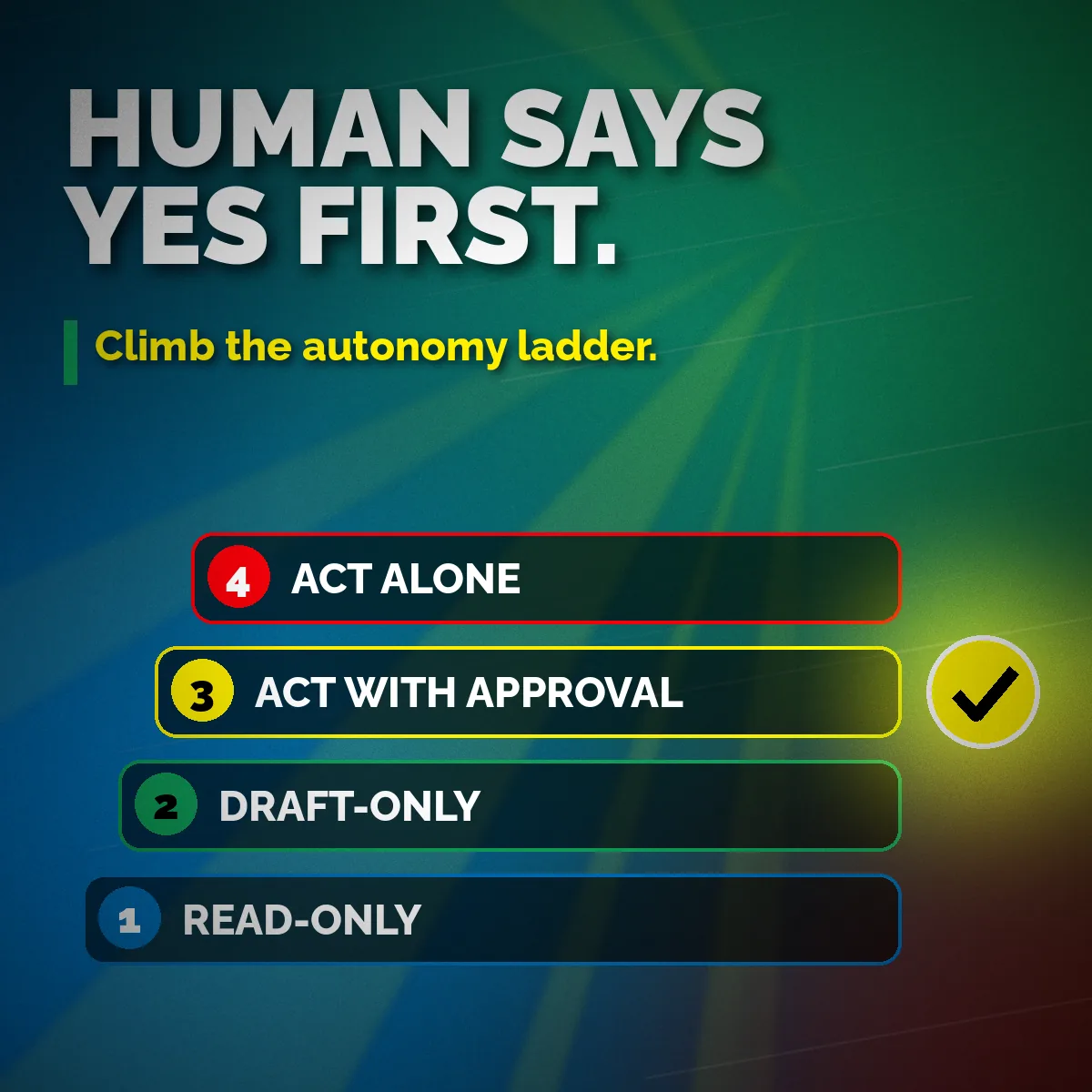
4. Set permissions and human checkpoints. Give it the minimum access it needs. No passwords in chat, no keys in shared docs, ever: credentials belong in a proper secret store, not in a prompt. Think of it as an autonomy ladder and climb one rung at a time:
- Rung 1, read-only: it looks and reports.
- Rung 2, draft-only: it prepares work and saves it for you to approve.
- Rung 3, act with approval: it does the thing after you say yes.
- Rung 4, act alone: reserved for low-stakes, easily reversible tasks that have run clean for weeks.
Put a human approval step before anything irreversible: sending to customers, spending money, publishing. AI can state wrong things with total confidence (we dug into why in Why Your AI Is a Confident Liar (And How Not to Get Burned)), so a human check isn’t optional.
5. Measure, review, repeat. Gartner’s list of what kills projects is a ready-made scorecard: cost, business value, risk controls4. Track four numbers in a simple sheet: hours saved, errors caught, cost per task and how often you had to step in. Start on free tiers (our rundown of genuinely free AI tools is a good place to begin), set a monthly spending cap before you begin, and remember 41% of small businesses in the Chamber survey use free AI tools9, so you don’t need a big budget to run a fair test. If the hours saved don’t beat the time you spend babysitting, that’s your answer. After two weeks, keep it, fix it or fire it. No ego, no sunk-cost drama.
Bonus rule: always leave a way to reach a human. Klarna learned that lesson in public so you don’t have to. And be upfront with customers when they’re dealing with AI.
Your Move
Agentic team mates are not magic and they’re not a scam. They’re a new kind of hire: fast, tireless, occasionally confidently wrong. The evidence points to cost, unclear value and weak controls as the big project-killers, not raw AI brainpower. That’s good news, because those are things a disciplined hustler can manage.
So here’s your 7-day mission. Day one: pick one pain point. Day two: write the half-page job description. Days three to five: run it as a simple workflow with you checking every output. Days six and seven: count the hours saved and the mistakes caught. Then decide. That’s it. No hype, just reps.
The Side Hustle Tribe exists to help 1,000 ambitious people turn their side hustles into main hustles by 2028, and the hustlers who win will be the ones who add smart team mates without losing control. Time to crush it. Ready to put your next step into action? Grow Your Hustle →
Where the numbers come from
Every figure above is named in the text and numbered here. Vendor-run surveys are marked as such, and second-hand sources are marked as second-hand.
- Mayfield, The Agentic Enterprise in 2026 (2026 CXO survey of 266 enterprise technology leaders), Mayfield, 2026. Vendor-run (venture firm) survey. mayfield.com
- OutSystems, Agentic AI Goes Mainstream in the Enterprise, but 94% Raise Concern About Sprawl (State of AI Development 2026, 1,900 IT leaders), OutSystems, 2026. Vendor-run survey, read via the company’s press release. outsystems.com
- Anthropic, Building effective agents, Anthropic, 2024. anthropic.com
- Gartner, Gartner Predicts Over 40% of Agentic AI Projects Will Be Canceled by End of 2027 (press release), Gartner, 2025. gartner.com
- McKinsey & Company, The state of AI in 2025: Agents, innovation, and transformation (Global Survey, 1,993 participants), McKinsey & Company, 2025. mckinsey.com
- CrewAI, 2026 State of Agentic AI Survey Report, CrewAI, 2026. Vendor-run survey. CrewAI report (PDF)
- Halkwinds Research, AI Agent Adoption Report 2026 (634 organisations), Halkwinds Research, 2026. Vendor-run survey. halkwinds.com
- Challapally, Pease, Raskar and Chari, The GenAI Divide: State of AI in Business 2025 (preliminary findings), MIT Project NANDA, 2025. The original MIT-hosted link now redirects, so this links to a mirror copy of the report PDF. mlq.ai mirror (PDF)
- U.S. Chamber of Commerce Technology Engagement Center (C_TEC), Empowering Small Business: The Impact of Technology on U.S. Small Business 2026 (survey of 3,732 small businesses, fielded with Teneo Research), U.S. Chamber of Commerce, 2026. uschamber.com report (PDF)
- Sheryl Estrada, MIT report: 95% of generative AI pilots at companies are failing (interview with the report’s lead author), Fortune, 2025. Second-hand source: news coverage and interview, not the report itself. fortune.com
- Huang et al., CRMArena-Pro: Holistic Assessment of LLM Agents Across Diverse Business Scenarios and Interactions, Salesforce AI Research (arXiv:2505.18878), 2025. arxiv.org
- Klarna, Klarna AI assistant handles two-thirds of customer service chats in its first month (press release, 27 February 2024), Klarna, 2024. Company-reported figures. klarna.com
- Fortune, As Klarna flips from AI-first to hiring people again, a new landmark survey reveals most AI projects fail to deliver (reporting on the CEO’s Bloomberg interview), Fortune, 2025. Second-hand source: it relays what the CEO told Bloomberg. fortune.com