

Same five questions, every single week. “Where’s my order?” “Can I return it?” “Do you ship to me?” Answering them from scratch eats the hours you meant to spend growing the hustle. This kit fixes that: a fact sheet, a master prompt, ten starter questions and a safety routine, so a general-purpose AI assistant can draft your replies and you stay in charge of what actually gets sent.
What this kit is. It works with any general-purpose AI writing assistant, so we’re deliberately not naming one. Everything here is about your process, not a particular product. Check the settings and terms of whichever tool you choose before you use it for customer messages.
What it isn’t. It isn’t legal advice. If a customer’s question touches refunds, consumer rights, tax, health or safety, check the rule that applies where you and your customer are, or ask a qualified adviser. Our guide to legal things to do before your first sale is a good place to start.
Step 1: Write Your Fact Sheet Before You Touch the AI
An AI assistant doesn’t know your business. UK government guidance says AI systems are not guaranteed to be accurate, and that large language models can create content that appears plausible but may actually be factually incorrect1. A fact sheet gives the assistant the real answers to work from, which beats letting it guess.
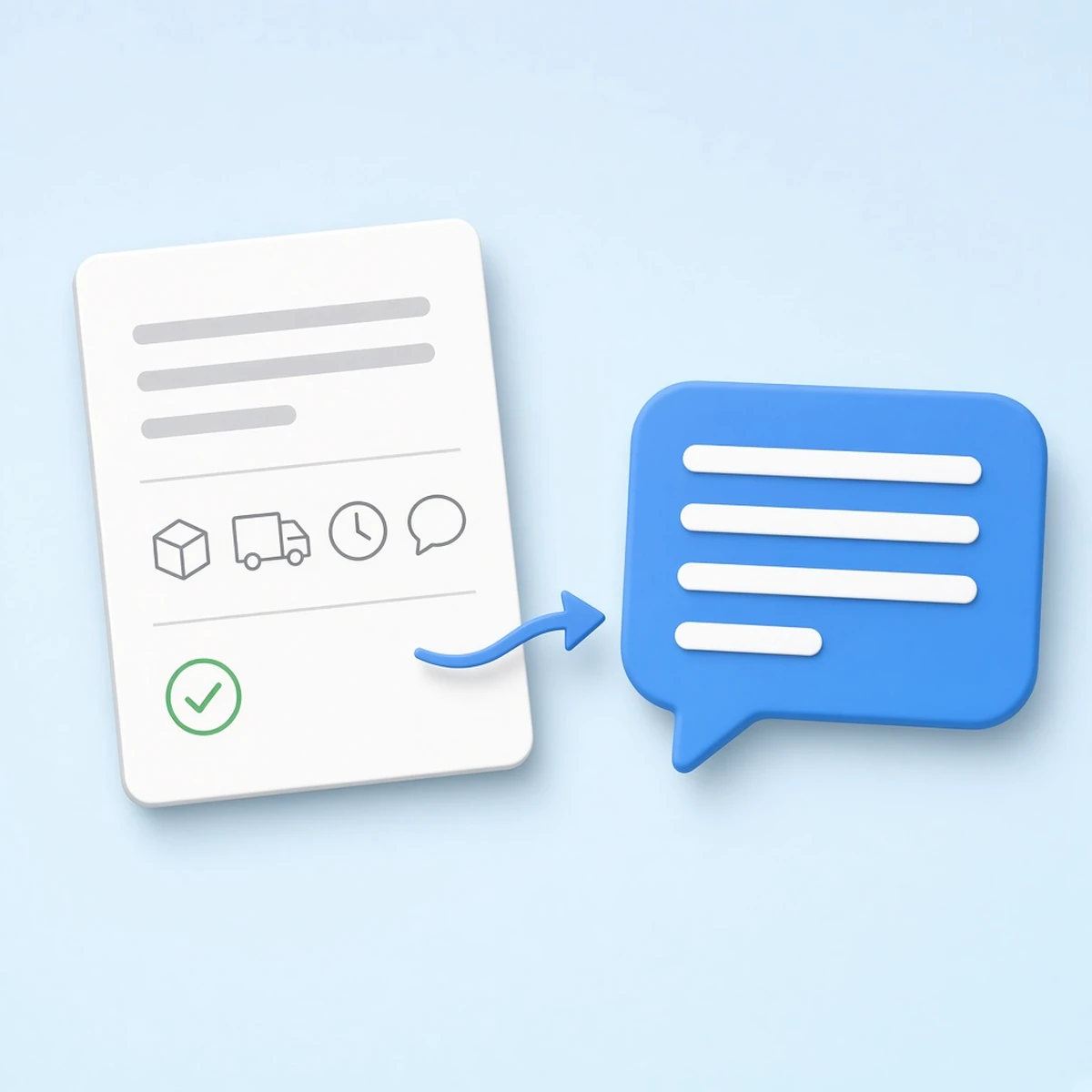
Open a plain document and write down, in your own words:
- Your products or services, with prices in the currency you actually charge.
- Where you ship or deliver, how long it usually takes, and who pays for it.
- Your returns, refunds and cancellations policy, exactly as it appears on your site.
- Your opening hours or typical reply time, and the best way to contact you.
- Anything you will never promise, such as medical results, guaranteed delivery dates or custom work you don’t offer.
Keep it to one page. Update it the moment something changes. This single page is the most valuable part of the kit.
Step 2: Use a Master Prompt
Paste your fact sheet into the assistant first, then use a prompt like this. Change the words in square brackets to suit your hustle.
Master prompt: “You are drafting customer replies for [your business name], a small online business. Use only the facts in the fact sheet above. If the customer asks something the fact sheet doesn’t cover, don’t guess: write ‘I need to check this and I’ll come back to you’ and list what I need to find out. Write in a warm, upbeat, plain-English tone, in short paragraphs, using [UK or US] spelling. Never promise refunds, delivery dates, results or legal outcomes. Finish with my name, [your name].”
Why it works: it limits the assistant to your facts, gives it a safe way to say “I don’t know”, and sets your voice once so you don’t have to repeat it. Our guide to getting an AI assistant to draft your first sales page shows the same idea for longer copy.
Ten Starter Questions, Ten Invented Sellers
Every seller below is invented, and every customer question is one you’ll recognise. For each, the right-hand column says what your fact sheet must contain before the assistant can draft a decent reply. If the fact isn’t on your sheet, add it first.
| Invented seller | Based in | Sells | Customer question | Fact your sheet must contain |
|---|---|---|---|---|
| Maya | United States | Scented candles | Where is my order? | Dispatch time, carrier name and how customers can track a parcel |
| Tama | New Zealand | Downloadable planners | I can’t open my file | Accepted file types, how to re-send the download link |
| Jess | Australia | Personalised mugs | Can I change the name I ordered? | Cut-off for changes, and whether custom items can be returned |
| Marcus | Cayman Islands | Photography sessions | Can I move my booking? | Rescheduling notice period and any deposit terms |
| Keisha | Bahamas | Handmade bags | Do you ship to my country? | List of countries you ship to and who pays delivery |
| Andre | British Virgin Islands | Boat day-trip bookings | What happens if the weather is bad? | Your written weather policy and how you tell customers |
| Thandi | South Africa | Baked gift boxes | Does this contain nuts? | Your ingredient list, kept current, and when to point customers to the label |
| Callum | United Kingdom | Paid newsletter | How do I cancel? | Where the cancel link is and how to confirm it worked |
| Priya | Canada | Digital templates | Can I use this for a client? | Your licence terms in one plain sentence |
| Aoife | Ireland | Knitwear | Is this item still in stock? | Where stock status lives and how often you update it |
Two of these deserve extra care. For the allergy and weather questions, the reply must come from your own policy and your own knowledge, not from an AI’s general knowledge. Safety-related answers are exactly where a confident but wrong reply can do real harm.
Reply Templates You Can Adapt
Paste a customer’s question (with personal details removed, see below) after the master prompt and ask for a draft. These five shapes cover most of what you’ll see. Fill the brackets from your fact sheet.
Order status: “Thanks for your message, [first name]. Your order left us on [date] with [carrier]. You can follow it with the tracking details we sent. If it hasn’t arrived by [date from your policy], reply here and we’ll look into it straight away.”
Delay or problem: “Thanks for your patience, [first name], and sorry for the wait. Here’s where things stand: [one honest sentence]. Our next update will be by [date]. If you’d rather change or cancel, here’s how under our policy: [policy sentence].”
Return or cancellation request: “Thanks for getting in touch. Here’s our returns policy in short: [paste your policy sentence]. To start, [step one]. Tell us if anything about your situation is different and we’ll take a look.”
Pre-sale question: “Great question! Here’s what we can tell you: [fact]. What we can’t promise is [limit]. If you’d like to go ahead, here’s the link: [product link].”
Thank-you and review nudge: “Thanks so much for your order, [first name]! If you’re happy with it, a short honest review helps other small-business shoppers. If something isn’t right, reply here first and we’ll look at it under our policy: [policy sentence].”
Read each draft out loud. If it doesn’t sound like you, edit it before sending, and tell the assistant what to change so the next draft starts closer.
Where AI Replies Go Wrong
The US National Institute of Standards and Technology (NIST) uses the word “confabulation” for generative AI producing confidently stated but erroneous or false content2. NIST also says confabulations are a natural result of how these models are designed, because they generate outputs that approximate the statistical distribution of their training data2. In plain English: a smooth, friendly reply can still be wrong.

That’s why the kit has human checks built in:
- Check every fact against your sheet. Dates, prices, policy wording, delivery promises and names. Don’t trust a sentence because it sounds sure of itself.
- Delete anything invented. If the draft mentions a discount, a policy or a deadline that isn’t on your fact sheet, remove it.
- Don’t let AI make decisions. Refunds, exceptions and complaints are yours to decide. The assistant drafts; you choose.
- Escalate the serious stuff. Anything legal, medical, safety-related or involving a dispute needs a human answer from you or an adviser.
UK government guidance for public servants puts it bluntly: as an end user, you take responsibility for a system’s outputs and should check that they’re accurate, and where risk is high you need human-in-the-loop oversight1. That guidance was written for the public sector, but the principle fits a one-person shop perfectly. If you want the longer story, read why your AI is a confident liar.
Protect Your Customers’ Data
Customer emails are full of personal information: names, addresses, order numbers, phone numbers. Australia’s privacy regulator, the Office of the Australian Information Commissioner (OAIC), notes that privacy obligations apply to any personal information put into an AI system, and recommends as best practice that organisations don’t enter personal information, particularly sensitive information, into publicly available generative AI tools3.
So build a habit that works anywhere in the world:
- Swap names for placeholders such as “Customer A” before you paste a message in.
- Remove addresses, phone numbers, emails and order numbers. The assistant doesn’t need them to draft a reply.
- Add the real details yourself after you’ve checked the draft.
- Read the tool’s terms and settings on how it handles what you type. The OAIC warns that some commercial AI products can use customer inputs for further training and development3.
Our guide to customer data privacy for side hustlers covers the wider picture, and your local rules may be stricter than the habits above.
Be Upfront About Where AI Helps
If you review and send each reply yourself, you’re simply a seller using a drafting tool, and the message is from you. If you put an AI chatbot in front of customers, official guidance says to say so. The OAIC advises that public-facing AI tools such as chatbots are clearly identified as such to users3, and the UK government’s AI playbook tells public bodies to clearly signpost when AI is interacting with members of the public1.
A simple line works: “Replies are drafted with AI help and checked by a person.” And keep it honest: tell customers what the tool does, and don’t oversell it.
Run a Ten-Minute Weekly Review
A kit gets better with use. Once a week:
- Scan the replies you sent and mark any you had to rewrite heavily.
- Add every new question to your fact sheet with its real answer.
- Fix the master prompt if the assistant keeps making the same mistake.
- Check your policies against your fact sheet so they still match.
After a month you’ll have a living FAQ. Turn the best answers into a page on your own site so customers can find answers before they need to ask. Our guide to your first paid order from a customer you’ve never met shows what customers want to see at that moment.
The Copy-and-Use Checklist
Copy this into your notes and tick it off before you send your first AI-drafted reply.
☐ I’ve written a one-page fact sheet with products, prices, shipping and returns.
☐ My fact sheet lists what I will never promise.
☐ I’ve saved my master prompt with my business name, tone and my name.
☐ I’ve told the assistant to say “I need to check” instead of guessing.
☐ I’ve written down my answers to the ten starter questions for my own hustle.
☐ I remove names, addresses, phone numbers and order numbers before I paste a message in.
☐ I’ve read the tool’s terms and settings on how it handles what I type.
☐ I check every date, price and policy sentence against my fact sheet before sending.
☐ I answer anything legal, medical or safety-related myself, never from a draft.
☐ If a chatbot talks to customers, it says clearly that it’s AI.
☐ I read every draft out loud and edit it into my voice.
☐ I’ve booked ten minutes each week to update the fact sheet.
Your Move
Pick the three questions you answered most often this month. Write the real answer to each in one plain sentence, put them in a one-page fact sheet, then draft your first three replies with the master prompt. Check them, edit them, send them. That’s your kit running.
A FAQ page on your own site gives customers somewhere to find those answers before they ask, and your own domain and hosting is the foundation for it. Get your domain and hosting sorted →
We’re helping 1,000 ambitious people turn their side hustles into main hustles by 2028. Yours could be next.
Where the numbers come from
This post makes no statistics claims. The guidance on AI accuracy, data and transparency comes only from official sources: the UK government, the US National Institute of Standards and Technology (NIST) and the Office of the Australian Information Commissioner (OAIC), listed below. We read every page on 5 November 2026. The UK government playbook is written for public bodies, so we’ve borrowed its principles rather than its rules. Guidance on AI changes quickly, so check the current version of each page before you rely on it. This is general information, not legal advice.
Sources
