

A shopper in Leeds finds your product, loves it and gets to the checkout. Then they see a price in a currency they don’t use, a payment page they don’t recognise, and a support inbox that answers at 3am their time. They close the tab.
That’s a real risk when you’re selling to the UK from abroad, because UK shoppers are not short of options: UK Finance’s 2026 payments report says around 45.9 million people, 80% of UK adults, bought goods or services online in 20251. To win their order, your shop has to feel local even when you’re in Toronto, Brisbane, Dublin, Cape Town or Nassau.
This guide covers the four things that make that happen:
- Pricing in pounds sterling (GBP), shown the way UK consumers expect.
- Payments UK shoppers already use, checked against current official and provider pages.
- VAT awareness for overseas sellers, for the UK only.
- Time zones for support hours and launches, with the clock-change dates that move your schedule.
It works from any of our markets: the US, Canada, Australia, New Zealand, Ireland, the Cayman Islands, the Bahamas, the British Virgin Islands and South Africa. Every figure is numbered to a source at the end.
1. Price in Pounds, and Make the Price the Price
UK shoppers compare prices in pounds, so show them pounds. A price that only appears in your home currency makes the buyer do the maths and guess at their bank’s exchange rate, and a guess is a reason to leave.
Start from your own numbers, not a currency converter. Work out your cost floor in your home currency first (our pricing guide walks through it), convert it, add room for exchange-rate swings, then pick a clean GBP price. £18 reads like a decision. £17.63 reads like a currency converter.
Here’s the part that can trip up sellers who are used to adding tax at the checkout. In the UK, the price a consumer sees is meant to be the full price. The UK government’s guidance on the Price Marking Order 2004 says it covers goods sold by traders to consumers, including online sales, and that the selling price must include VAT and all other taxes2. The Order also says prices must be shown in sterling, and a trader who indicates it will accept another currency must also show either the price in that currency or the conversion rate, plus any commission2. (That order applies in Great Britain; Northern Ireland has its own version2.)
Delivery counts too. The Competition and Markets Authority (CMA) says traders must give the total price up front, including mandatory charges such as a delivery fee or a tax like VAT, and that hiding fees until later in the checkout, sometimes called “drip pricing”, is illegal. Since 6 April 2025 the CMA can fine a business directly, up to 10% of its turnover or £300,000, whichever is greater3, and that power reaches sellers based abroad whose shops target UK consumers4. Optional extras, like faster delivery, can be shown separately3.
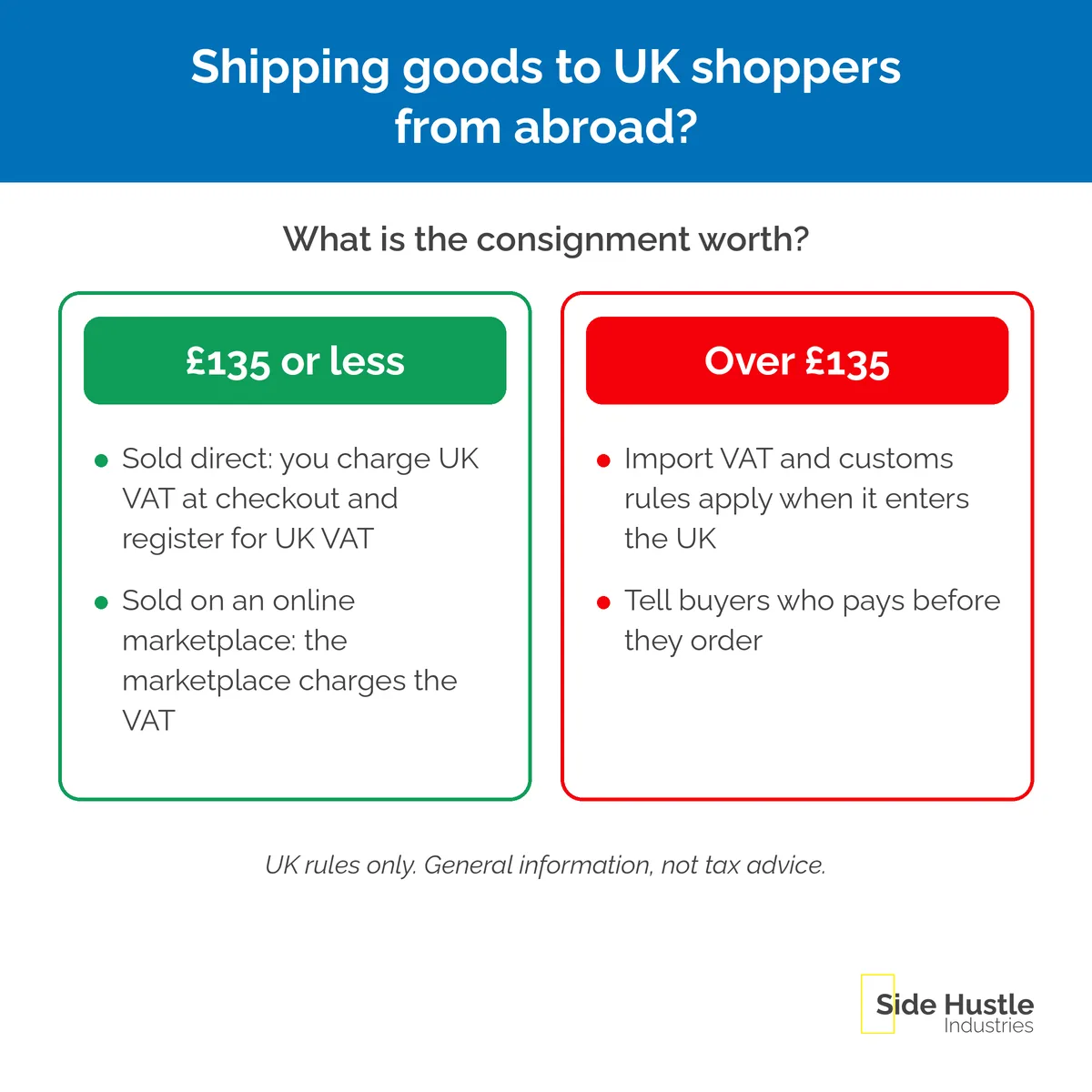
One more surprise to design out: the bill at the door. GOV.UK tells UK shoppers that for goods worth more than £135 in total sent from abroad, they will have to pay VAT to the delivery company before delivery or on collection, and Customs Duty can apply too5. If your typical order goes over £135, tell buyers clearly before they pay, or look at shipping options where those charges are settled before the parcel arrives.
Your pricing checklist:
- Show GBP prices on product pages and at checkout.
- Make the headline price the full price for consumers, with mandatory delivery included.
- Round to clean pound prices that still clear your cost floor.
- Say plainly who pays any import charges on bigger orders.

2. Get Paid the Way the UK Pays
Good news: you don’t need anything exotic. UK Finance reports that card payments made up 64% of all UK payments in 2025 and that cards remain the main way people pay online, directly or through mobile wallets1. It also counts around 37.6 million consumers, more than six in ten adults, registered for at least one mobile wallet in 20251. So your checkout needs cards first, with wallet buttons close behind.
Expect strong authentication. The Financial Conduct Authority (FCA) explains that since 14 September 2019, rules in the Payment Services Regulations 2017 have changed how banks and payment providers check that the person making a payment is allowed to make it6. In practice, a UK cardholder may be asked to confirm an online payment with their bank, for example in a banking app. Use a checkout provider that supports this (often labelled 3D Secure), or good orders can fail at the last step. Our guide to getting paid by a customer you’ve never met covers payment links and fraud checks in more detail.
Don’t add a card fee. If both your payment provider and your customer’s card provider are in the UK, UK regulations ban any fee for paying with a consumer card. If your payment provider is outside the UK, any fee you add must not be more than the card actually costs you7. The simplest route either way: build your payment costs into the price.
Consider pay by bank. Pay by bank uses open banking to let shoppers pay straight from their bank account instead of using a card8. Open Banking Limited says the UK’s nine largest banks and building societies are required to take part, and only apps and websites from firms regulated by the FCA or a European equivalent can join its directory9. Availability for you depends on your provider and where your business is based. Stripe’s documentation, for example, lists Pay by Bank for customers in the UK and a set of other European countries, available to Stripe accounts in places including the US, Canada, Australia and Ireland, with payments from 0.50 GBP up to 10,000 GBP by default8. New Zealand, South Africa, the Cayman Islands, the Bahamas and the British Virgin Islands aren’t on that list, so if you’re based there, check what your own provider supports.
Know where Buy Now Pay Later stands. UK Finance found that around 1 in 5 UK adults (22%) used Buy Now Pay Later in 20251. The rules changed recently: the FCA started regulating Deferred Payment Credit, the interest-free kind of Buy Now Pay Later, on 15 July 2026. Lenders now need FCA authorisation or a place in its temporary permissions regime, and the FCA explains how to check a lender on its Firm Checker10. If you add a Buy Now Pay Later option, use a lender that passes that check.
3. VAT: What the UK Expects From Overseas Sellers
This section covers the UK only, and it’s general information, not legal or tax advice. VAT rules depend on what you sell, how you sell it and where your goods are when you sell them. Check HMRC’s guidance on GOV.UK, or ask a qualified adviser, before you act.
The headline for overseas sellers: there may be no threshold to hide under. UK businesses only have to register once taxable turnover passes £90,000, but GOV.UK says you must also register, regardless of taxable turnover, if you and your business are based outside the UK and you supply any goods or services to the UK (or expect to in the next 30 days)11. HMRC treats you as an overseas seller if you have no UK establishment, and says that being incorporated in the UK or having a registered, serviced or virtual office is unlikely to be enough on its own to count as established12. The standard rate of VAT is 20%13.
What happens next depends on how you sell:
- Goods shipped from abroad, sold direct, consignment of £135 or less: HMRC says you must charge and account for UK VAT at the point of sale, which means registering for UK VAT. The £135 limit applies to the whole consignment, not each item. If the buyer is a UK VAT-registered business that gives you its VAT number, the business accounts for the VAT instead12.
- Consignments over £135: normal import VAT and customs rules apply12, which is where that bill at the door comes from.
- Goods sold through an online marketplace: for consignments of £135 or less shipped from outside the UK, HMRC says the marketplace charges and accounts for the VAT. If you’re an overseas seller and your goods are already in the UK when they sell, the marketplace is liable for VAT on those sales too, but you pay any import VAT and Customs Duty when you bring that stock into the UK14.
- Goods held in the UK and sold direct: if you’re an overseas seller with goods of any value in the UK at the point of sale, you must register, charge and account for VAT. If all your sales are zero-rated, HMRC lets you apply for exemption from registration12.
- Selling from Ireland or elsewhere in the EU to Northern Ireland: different rules apply, so read HMRC’s Northern Ireland guidance12.
- Digital services to UK consumers: HMRC says these supplies are liable to UK VAT, sellers based outside the UK need to register, and if you sell through a third-party platform or marketplace that takes the payment, handles the download or sets the terms of sale, the platform usually accounts for the VAT instead of you. Check your platform’s terms to see which applies15.
A change to watch: HMRC published draft legislation on 13 July 2026 to remove the £135 customs duty relief for low-value imports and introduce new customs arrangements, to come into force by October 2028 at the latest16. That draft is about customs duty and declarations, so keep an eye on GOV.UK for the details.
UK consumer law matters as much as tax. Our legal checklist for your first sale covers UK distance-selling rules alongside six other markets.
4. Run Your Support Clock on UK Time
The UK uses Greenwich Mean Time (GMT) in winter and British Summer Time (BST), one hour ahead, in summer. GOV.UK lists the next changes: clocks go back on 25 October 2026, forward on 28 March 2027 and back again on 31 October 202717. Each change moves your gap to London by an hour, and if your country changes its clocks on different dates, the gap shifts more than once.
How that plays out across our markets:
- United States: NIST says daylight saving time in 2026 runs from 8 March to 1 November18. For the week between the UK change on 25 October and the US change on 1 November, your gap to London is an hour shorter than usual. NIST’s rule for the start of daylight saving time puts the 2027 start on 14 March, two weeks before the UK moves on 28 March18, so the shorter gap comes back for those two weeks.
- Canada: most provinces follow the same North American dates as the US19. Most of British Columbia is different: the province has moved to permanent Pacific time, so its clocks won’t go back on 1 November 202620. From then on, the gap to London from there only changes when the UK’s clocks do.
- Ireland: Citizens Information says Ireland has the same time as the UK21. No time maths, but bank holidays still differ.
- New Zealand: daylight time runs from 27 September 2026 to 4 April 202722, which is the opposite season to the UK. Your gap to London moves at each of the four changes.
- Everywhere else, including Australia, South Africa and the Caribbean: check whether and when your own clocks change. If they stay put while the UK’s change, your gap to London still moves twice a year17.
Turn that into habits:
- Publish support hours in UK time, and say how fast you reply. A promise you keep beats a promise of instant replies.
- Put the clock-change dates in your calendar and adjust any scheduled emails, posts and auto-replies.
- Check UK bank holidays before a launch. They differ across the UK: GOV.UK lists Christmas Day on 25 December 2026 and Boxing Day on 28 December 2026 for all of the UK, St Andrew’s Day on 30 November 2026 and the 2 January holiday on 4 January 2027 in Scotland, and St Patrick’s Day on 17 March 2027 in Northern Ireland23. Plan deliveries and replies around those dates.
- Time launches for UK waking hours. A launch email that lands overnight in London sits under everything that arrives by morning.
Your Move
Selling into the UK from abroad comes down to four moves: price in pounds with nothing hidden, offer the payment methods UK shoppers already use, know which VAT rules apply to the way you sell, and run your support clock on UK time.
Your checklist:
- Set GBP prices that include everything a consumer must pay, with delivery included.
- Check that your checkout handles cards, wallets and strong authentication, and see whether pay by bank is available for your business location.
- Work out which UK VAT scenario you’re in: direct or marketplace, goods or digital, under or over £135.
- Add the UK clock-change and bank holiday dates to your calendar, then publish your support hours in UK time.
One more time: this is general information about UK rules, not legal or tax advice. Rules change. Check HMRC’s guidance on GOV.UK, or talk to a qualified adviser, before you rely on any of it.
The UK rewards sellers who make buying easy, and none of this needs a UK office, just a little discipline. Ready to take your hustle further? Grow Your Hustle →
Where the numbers come from
Every rule, date and figure above comes from the page below. VAT, customs and consumer-pricing points come from UK government, regulator or legislation pages; payment figures come from UK Finance (a trade body) and provider documentation, marked as such. All pages were read on 15 October 2026. Rules change, so check the page before you rely on it.
- UK Finance, UK Payment Markets 2026: Summary (2025 data; trade body report based on member data), UK Finance, 2026. ukfinance.org.uk
- Department for Business and Trade, Price Marking Order 2004: government guidance, GOV.UK, 2025. gov.uk
- Competition and Markets Authority (CMA), Providing clear and accurate information about prices: summary (CMA209, price transparency), GOV.UK, 2026. gov.uk
- UK Parliament, Digital Markets, Competition and Consumers Act 2024 (c. 13), sections 149 and 182(6) (direct fining powers; s182(6) in force 6 April 2025), legislation.gov.uk, 2024. legislation.gov.uk
- HM Revenue & Customs, Tax and customs for goods sent from abroad: Tax and duty, GOV.UK, 2026. gov.uk
- Financial Conduct Authority (FCA), Strong Customer Authentication, FCA, 2023. fca.org.uk
- UK Parliament, Consumer Rights (Payment Surcharges) Regulations 2012 (S.I. 2012/3110), regulations 4, 6A and 6B (6A and 6B inserted 2018), legislation.gov.uk (revised text), 2026. legislation.gov.uk
- Stripe, Pay by Bank payments (payment method properties and business locations; provider documentation), Stripe Docs, 2026. docs.stripe.com
- Open Banking Limited, What is open banking? (open banking FAQs), Open Banking Limited, 2026. openbanking.org.uk
- Financial Conduct Authority (FCA), Buy Now Pay Later (Deferred Payment Credit regulated from 15 July 2026), FCA, 2026. fca.org.uk
- HM Revenue & Customs, Register for VAT: When to register, GOV.UK, 2026. gov.uk
- HM Revenue & Customs, Charging VAT on goods sold direct to customers in the UK, GOV.UK, 2026 (last updated 30 January 2026). gov.uk
- HM Revenue & Customs, VAT rates, GOV.UK, 2026. gov.uk
- HM Revenue & Customs, Charging VAT when using an online marketplace to sell goods to customers in the UK, GOV.UK, 2025 (last updated 20 June 2025). gov.uk
- HM Revenue & Customs, VAT rules for supplies of digital services to consumers, GOV.UK, 2022 (last updated 28 March 2022). gov.uk
- HM Revenue & Customs, Reforming the customs treatment of low value imports into the UK (policy paper and draft legislation, Finance Bill 2026-27), GOV.UK, 13 July 2026. gov.uk
- UK Government, When do the clocks change?, GOV.UK, 2025 (last updated 24 November 2025). gov.uk
- National Institute of Standards and Technology (NIST), Daylight Saving Time (DST), NIST, 2026 (updated 9 February 2026). nist.gov
- National Research Council Canada, Time zones and daylight saving time (the page says it is under review and some details change from 1 November 2026), NRC, 2022. nrc.canada.ca
- Province of British Columbia, B.C.’s new time zone (Pacific time), gov.bc.ca, 17 September 2026. gov.bc.ca
- Citizens Information Board (Ireland), When do clocks change in Ireland?, citizensinformation.ie, 2026 (edited 6 January 2026). citizensinformation.ie
- New Zealand Government, Daylight saving (dates for 2026 to 2029), govt.nz, 2026 (last updated 11 August 2026). govt.nz
- UK Government, UK bank holidays (England and Wales, Scotland, Northern Ireland), GOV.UK, 2026. gov.uk
