

You’ve made a few sales to friends, a stranger has asked for your price list, and someone has said the word “register”. Register what, though? And with whom? Search for it and you’ll find a dozen agencies, a few paid services offering to do it for you, and not much plain English.
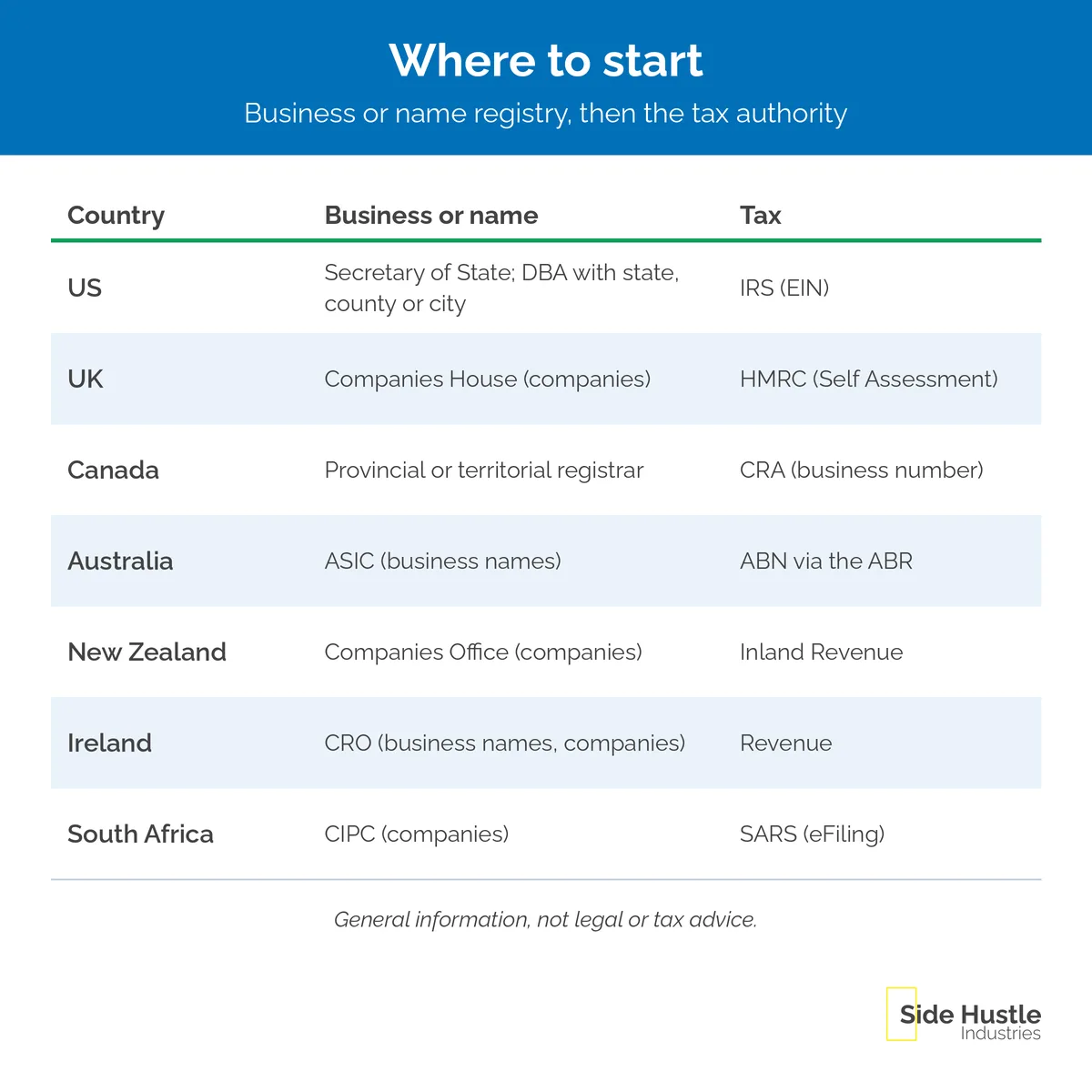
Here’s the short version, Tribe. When you register your side hustle, you’re usually doing two separate things: registering the business itself (or its name) and registering with the tax authority. This post walks through where to start for each in seven markets: the United States, the United Kingdom, Canada, Australia, New Zealand, Ireland and South Africa. The Cayman Islands, the Bahamas and the British Virgin Islands get their own posts.
Before we start: this is general information, not legal or tax advice. It covers the starting point for an individual setting up in their own country, and the official body that handles each step. Rules change, and your situation may have twists this post can’t see. Check the official page for your country, or talk to a qualified professional, before you act. Every rule and figure below is numbered to an official source at the end, all read on 15 October 2026.
If you’ve already read The 5 Legal Things to Do Before Your First Sale, think of this as the zoomed-in version of step 1 and the start of step 2. Same facts, more detail on the “where do I actually go” part.
1. Two Registrations, Not One
Most confusion comes from mixing up two different things.
Business registration is about the legal form of your business and the name it trades under. A sole trader (called a sole proprietor in the US, Canada and South Africa) is you, trading in your own right. A company or LLC is a separate legal entity that has to be formed with a registry before it exists. And if a sole trader trades under a brand name rather than their own name, many places want that name registered too.
Tax registration is about telling the tax authority you have business income, and getting whatever number it uses to track you. That’s separate from the business registry, even when one form feeds the other.
Three questions sort out almost every case:
- Are you trading as yourself, or forming a company? Trading as yourself is the simpler set-up. A company adds paperwork and annual filings in exchange for separating the business from you.
- Are you using your own name or a brand name? “Priya Shah” and “Priya Shah Ceramics” can be treated very differently.
- What does your tax authority need from you, and when? That’s an income tax question first. Sales tax, VAT and GST registration usually depend on turnover, and the legal checklist post covers those thresholds market by market.
Not sure about structure yet? Start as a sole trader where that’s allowed, and revisit once the hustle has steady sales. Amounts below are in each country’s own currency, labelled where it isn’t obvious.

2. United States and Canada
United States. The U.S. Small Business Administration (SBA) says you’re automatically a sole proprietorship if you do business activities but don’t register as any other kind of business1. Forming an LLC, corporation or partnership is different: those generally register with the state, and the SBA says most states require registration with the Secretary of State’s office, a Business Bureau or a Business Agency1.
Using a brand name? That’s a “doing business as” (DBA) name, also called a trade name, fictitious name or assumed name. The SBA says you might need to register it with your state, county or city, and that most states require registration if you use one. Requirements vary by structure and location, so check with your state and local government offices1.
Then the federal side. The Internal Revenue Service (IRS) issues the Employer Identification Number (EIN), a federal tax ID number. Applying directly with the IRS is free, and the IRS warns to beware of websites that charge for one2. Do you need one? The IRS says you generally need an EIN to hire employees, operate a partnership or corporation, or pay certain federal excise taxes, among other situations. (Sales tax is a state matter: the seller’s permit comes from your state, as the legal checklist post explains.) If you’re forming a corporation or LLC, form it with the state first, or the EIN application may be delayed2. The SBA’s list of documents banks commonly ask for gives an EIN, or a Social Security number if you’re a sole proprietorship, though each bank sets its own requirements and some may ask for more1.
A US sole proprietor reports business income on Form 1040 with Schedule C, and self-employment tax on Schedule SE3.
Canada. The Government of Canada says most businesses need to register with the provinces and territories where they plan to do business. In some cases, a sole proprietorship operating under the owner’s own name doesn’t need to, and Newfoundland and Labrador has no provincial registration for sole proprietorships or partnerships at all4. Your provincial or territorial business registrar has the details.
At the federal level, the Canada Revenue Agency (CRA) issues the business number (BN). Not every business needs one. The CRA says you need a BN if you incorporate or need a GST/HST, payroll or other CRA program account, and that an unincorporated business only needs one when it registers for a CRA program account5. Register in British Columbia, Manitoba, Nova Scotia, Ontario or Saskatchewan and you’ll automatically receive your federal BN as part of the provincial registration4.
Self-employment income goes on your personal return, calculated on Form T21256. GST/HST registration is its own question with its own threshold, covered in the legal checklist post.
3. United Kingdom and Ireland
United Kingdom. GOV.UK says you can start trading as a sole trader straight away without registering, using your own name or a trading name7. “Registering as a sole trader” in the UK means registering with HM Revenue and Customs (HMRC) for Self Assessment. You must do that if you earn more than £1,000 from self-employment in a tax year (6 April to 5 April), and you can choose to register earlier7. The £1,000 is gross trading income, before expenses8.
The timing rule is the one people miss. You have until 6 months after the end of the tax year to tell HMRC9, which means 5 October. So for income first earned between 6 April 2026 and 5 April 2027, that’s 5 October 2027. Miss it and you could get a penalty10.
Forming a limited company works differently. GOV.UK says you must register the company before you start trading11. You register with Companies House, and you’ll usually be set up for Corporation Tax at the same time. Registering online costs £100, and the company is usually registered within 24 hours. You may also need to verify your identity first and use the personal code you get from Companies House12.
Ireland. Revenue says you must register for tax when you become a sole trader13. You need a Personal Public Service Number (PPSN) first, and your tax reference number will be the same as your PPSN once you register. PAYE employees starting a side hustle can register for Income Tax self-assessment through myAccount14.
Trading under a name that isn’t your true surname? The Companies Registration Office (CRO) says registration is obligatory, and the application must reach the CRO within one month of adopting the name. Its own example: John Murphy must register “Murphy Builders”, but not “Murphy” or “John Murphy”. The fee is €20 filed electronically or €40 on paper15. A registered business name doesn’t protect the name from duplication, so check it against company names and trade marks before you print anything15.
A company is a separate legal entity registered with the CRO, and a private company limited by shares (LTD) can have a single director16. Revenue says a new company must register for tax too13.
4. Australia, New Zealand and South Africa
Australia. Two registrations matter. The Australian Business Number (ABN) is a unique 11-digit number that identifies your business to the government, other businesses and the public. It doesn’t replace your tax file number (TFN)17. Not everyone needs one: to get an ABN you need to be running a business or other enterprise. Registering through the Australian Business Register (ABR), which the Australian Taxation Office (ATO) manages, is free17.
Then the name. The Australian Securities and Investments Commission (ASIC) says you must register a business name if you run a business in Australia and are not trading under your own name, meaning your first name and surname and nothing else. John Smith doesn’t need to register “John Smith”, but would need to register “John Smith Gardening”18.
New Zealand. Business.govt.nz says a sole trader doesn’t need to register themselves or their business with a government agency. You only need to tell Inland Revenue that you’ve started working for yourself as a sole trader, using your IRD number and myIR account19. The same page recommends a New Zealand Business Number (NZBN), a unique identifier any New Zealand business can have19.
A company is incorporated with the Companies Office. You create an online account, reserve a name for NZ$10 plus GST, and apply to incorporate for NZ$118.74 plus GST20. After that, there’s an annual return of NZ$49.74 plus GST each year20. Registered companies are allocated an NZBN and included on the NZBN Register automatically21.
South Africa. The South African Revenue Service (SARS) says sole traders have no requirement to register with the Companies and Intellectual Property Commission (CIPC). You register for personal income tax directly with SARS via eFiling and declare your business income each year on the ITR12 return22. A sole proprietorship can trade under your own name or a trade name, and that trade name doesn’t create a separate legal entity23.
Companies are the other route. SARS says legal entities such as private companies must register with the CIPC24, and once a company is registered there, SARS automatically generates its company income tax reference number22. The CIPC itself says it isn’t necessary for all businesses to register with it, and for informal businesses and sole proprietors there may not be enough benefit. A registered company has ongoing duties, including an annual return and annual fee, whether it trades or not25.
Before you register anything, it’s worth knowing what you’ll charge. How to price your first product covers that, and your first paid order from a customer you’ve never met covers what happens when the money lands.
Your Move
Registration feels bigger than it is. In all seven markets, the core job is the same: make sure the tax authority knows about your business income, and register a name or company only if you’ve chosen one.
Find your row and take the first step:
- US: decide sole proprietor or entity, check your state’s DBA rules, and get an EIN free from the IRS if you need one.
- UK: register for Self Assessment once your trading income (before expenses) passes £1,000 in a tax year, and tell HMRC by 5 October after that tax year ends.
- Canada: check your provincial registrar, then get a BN if you need a CRA program account.
- Australia: apply for a free ABN if you’re running a business, and register a business name if it isn’t your own name.
- New Zealand: tell Inland Revenue you’re a sole trader, and consider an NZBN.
- Ireland: register with Revenue, and register a business name with the CRO within a month of adopting it.
- South Africa: register for personal income tax via SARS eFiling. A CIPC registration is only needed if you form a company.
One more time: this is general information, not legal or tax advice. Rules change, and your situation may differ. Check the official body named in each section, or a qualified professional in your country, before you rely on any of it.
Keep it simple, keep it legal, and grow from there.
Where the numbers come from
Every rule, fee and date above comes from the official page below: government departments, tax authorities, business registries and legislation. All pages were read on 15 October 2026. Rules and fees change, so check the page before you rely on it.
- U.S. Small Business Administration (SBA), Launch your business (choose a business structure; register your business; DBA names; get federal and state tax ID numbers; open a business bank account), SBA, 2026. sba.gov
- Internal Revenue Service (IRS), Get an employer identification number, IRS, 2026 (page last reviewed or updated 19 August 2026). irs.gov
- Internal Revenue Service (IRS), Sole proprietorships, IRS, 2026 (page last reviewed or updated 28 June 2026). irs.gov
- Government of Canada, Registering a sole proprietorship or partnership, Canada.ca, 2026. canada.ca
- Canada Revenue Agency (CRA), Business number and CRA program accounts: When you need a BN, Canada.ca, 2026. canada.ca
- Canada Revenue Agency (CRA), Sole proprietorships and partnerships, Canada.ca, 2026. canada.ca
- GOV.UK, Become a sole trader, UK Government, 2026. gov.uk
- GOV.UK (HM Revenue and Customs), Tax-free allowances on property and trading income (trading allowance; gross income), UK Government, 2026. gov.uk
- UK Parliament, Taxes Management Act 1970, section 7 (notice of liability to income tax: 6 months from the end of the year of assessment), legislation.gov.uk (revised text), 2026. legislation.gov.uk
- GOV.UK (HM Revenue and Customs), Check how to register for Self Assessment, UK Government, 2026. gov.uk
- GOV.UK, Set up a private limited company: Limited companies, UK Government, 2026. gov.uk
- GOV.UK (Companies House), Set up a private limited company: Register your company, UK Government, 2026. gov.uk
- Revenue (Office of the Revenue Commissioners), Registering for tax, Revenue, 2026 (published 4 June 2026). revenue.ie
- Revenue (Office of the Revenue Commissioners), How to register for tax as a sole trader, Revenue, 2025 (published 10 October 2025). revenue.ie
- Companies Registration Office (CRO), Registering a Business Name, CRO, 2026. cro.ie
- Companies Registration Office (CRO), Registering a Company, CRO, 2026. cro.ie
- Australian Government, Register for an Australian Business Number (ABN), business.gov.au, 2026. business.gov.au
- Australian Securities and Investments Commission (ASIC), Register a business name, ASIC, 2026. asic.gov.au
- New Zealand Government (MBIE), Becoming a sole trader, business.govt.nz, 2026. business.govt.nz
- New Zealand Companies Office, Incorporating a company, Companies Register, 2026. companiesoffice.govt.nz
- New Zealand Companies Office, NZBN and the Companies Register, Companies Register, 2026. companiesoffice.govt.nz
- South African Revenue Service (SARS), SARS Small Business Essential Tax Guide (leaflet, updated 13 April 2026), SARS, 2026. sars.gov.za
- South African Revenue Service (SARS), Sole Proprietorship, SARS, 2026. sars.gov.za
- South African Revenue Service (SARS), Starting a business and tax, SARS, 2026. sars.gov.za
- Companies and Intellectual Property Commission (CIPC), About Registering a Business, CIPC, 2026. cipc.co.za
