

Most first websites don’t stall on code. They stall on a name. You open a registrar’s search box, type an idea, see “taken”, try twelve more, and three evenings later you still own nothing. Meanwhile your shop, your portfolio or your booking page sits in a notes app.
Here’s the mindset shift: your first domain name is a decision, not a masterpiece. You can add a second domain later. What hurts is never picking one at all, or picking one you can’t legally keep.
So this post gives you a 10-minute checklist. Three minutes to brainstorm and stress-test the name. Three minutes to choose your ending, whether that’s .com or a country domain like .co.uk, .ca, .com.au, .co.nz, .ie or .co.za. Four minutes to register it properly so it stays yours.
Every country rule below was checked against the official registry or the body that runs it, not a reseller’s sales page. Where a registry asks for proof that you’re local, we say so plainly, so you don’t pay for a name and then get asked for paperwork you don’t have.
Grab a timer. You’ve got this.
The 10-Minute Mindset: Good Enough Beats Perfect
Before the checklist, set three rules for yourself. They’re what turn this from a week of agonising into a short, focused session.
Rule 1: Clear beats clever. A name people can spell after hearing it once beats a witty pun they’ll type wrong. If you have to explain the joke, it isn’t helping.
Rule 2: Your business name and your domain can differ. If “Harbour Lane Candles” is taken as a domain, “harbourlanecandles.co.uk” or “shopharbourlane.com” can still point customers to the same brand. A domain is an address, not your identity.
Rule 3: Done today beats perfect next month. A domain you register now lets you set up email, build a holding page and start collecting interest. A perfect name you’re still hunting for does none of that.
This is a stoic call more than a creative one. You can’t control what’s already registered. You can control how quickly you move past it. Set the timer for ten minutes, follow the steps, and make the call when it rings.
One more thing before you start: have your business details open. That means your legal or registered business name if you have one, any business or tax number, and a sentence on what you sell. Several country domains ask for these, and having them ready is what keeps this to ten minutes rather than ten days.
Minutes 1 to 3: Brainstorm and Stress-Test the Name
Minute 1: write five candidates. Use your business name, your name plus what you do, or what you sell plus where you sell it. A dog groomer in Halifax, Canada, might write: tidypawsgrooming, tidypawshalifax, groomwithtidypaws, tidypaws, and her own name plus “grooming”. Don’t search yet. Just write.
Minute 2: run each one through the stress test. Cross a name off if it fails any of these:
- The radio test. Say it out loud to someone (or to your phone’s voice recorder). Could they type it correctly without seeing it? Watch for double letters across words, homophones and numbers that could be written as words.
- The length test. Shorter is easier to type on a phone and fit on a label. If it won’t fit comfortably on a business card in readable type, trim it.
- The hyphen test. Hyphens work technically, but people forget them. Use one only if the clean version is taken and you can live with explaining it.
- The “means something else” test. Read the run-together version slowly. Some names spell an unfortunate word when the spaces disappear.
- The growth test. “Brisbanebirthdaycakes” is clear today, but will it still fit if you add wedding cakes or ship to Sydney next year?
Minute 3: check it isn’t somebody else’s brand. Do a quick web search for each survivor, and search your national trademark office’s free database for the exact words. You’re not doing a legal clearance here. You’re avoiding the obvious mistake of building on a name a known business already uses in your field. Building on someone else’s name is how a small business ends up in a dispute it can’t afford.
By the end of minute three, you should have two or three names left. Rank them.
Minutes 4 to 6: Pick Your Ending (.com or a Country Domain)

Now choose the ending, the part after the dot. For most first-time builders it comes down to two options.
A .com. It’s the default for many people, and it’s open worldwide. Verisign, which runs .com, describes it as an unrestricted top-level domain open to any internet user anywhere in the world1. If you sell online across borders, live in a market without a country domain you can easily use, or just want the most familiar ending, start here.
A country domain. A .co.uk, .ca, .com.au, .co.nz, .ie or .co.za tells visitors you’re local. That can matter for a business that serves one country: a tradesperson, a café, a local delivery service. The catch is that some country registries only let you register if you can prove a connection to that country, and one of them (.com.au) also cares about how the name relates to your business.
A simple way to decide:
- You sell mainly in one country and you qualify there? Get that country’s domain first. Add the .com too if it’s available and you can afford both.
- You sell across borders, or you’re not sure yet? Start with .com.
- The .com is taken but the country domain is free? The country domain is a perfectly good home, as long as you meet its rules.
Cayman Islands, Bahamas and BVI builders: a .com is the simplest starting point, because it has no country requirement. If you want your local country ending instead, check that registry’s current rules directly before you pay. We haven’t covered those three registries here, so we’re not going to guess.
Whatever you pick, search the exact name with your chosen ending at a registrar, and note who runs the domain. The next section tells you what each registry expects.
Country Domain Rules at a Glance
Here’s what each registry or its policy body says, in plain words. Rules change, so treat this as your starting point and confirm on the registry page linked in the sources if you’re close to a line.
.com (worldwide). No country requirement. As above, Verisign describes .com as unrestricted1. A freelance designer in Miami, US, a dive shop in George Town, Cayman Islands, a surf school in Nassau, the Bahamas, and a charter-boat business in Tortola, BVI, can all register on equal terms.
.co.uk (United Kingdom). Open. Nominet’s Rules of Registration say it does not restrict who can apply in .co.uk and .org.uk2. You don’t need to be a UK company. A maker in Belfast or a seller in Dublin shipping into Britain can both register one.
.ca (Canada). You must meet CIRA’s Canadian Presence Requirements. Common qualifying categories include Canadian citizens, permanent residents, Canadian corporations and owners of a trademark registered in Canada, and CIRA can ask you to prove the category you picked3. A groomer in Halifax who is a Canadian citizen qualifies. A store in Austin, US, that only ships to Canada doesn’t qualify on shipping alone; it would need a category such as a Canadian corporation or a trademark registered in Canada.
.com.au (Australia). Two hurdles. First, you need an Australian Presence and must be a commercial entity, for example a company registered with ASIC or a person or business with an Australian Business Number. Being an Australian citizen or permanent resident gives you an Australian Presence, but for .com.au you still need to be a commercial entity, such as a sole trader with an ABN4, 5. Second, the name itself must connect to you. It has to match or be an acronym of your company, business or personal name, match your Australian trade mark, or match or be a synonym of a product, service, event, activity or premises you actually offer when you apply4. The provider must also validate your Australian Presence, for example with an ABN, when a name is created, renewed or transferred5. So a cake business in Brisbane trading as “Hello Crumb” can register hellocrumb.com.au; registering a name unrelated to the business won’t pass the test. If you haven’t registered your business name yet, our guide to registering your side hustle in the US, UK, Canada, Australia, NZ, Ireland and South Africa covers where to start.
.co.nz (New Zealand). Open and first come, first served. The Domain Name Commission says anyone over 18 can register a .nz domain name and you don’t have to be in New Zealand6. Under the .nz Rules, you must be an identifiable individual over 18 or a lawfully constituted entity, and the Commission can ask you to verify your identity at any time7. A Wellington tutor and a Johannesburg app studio selling to Kiwi customers can both register.
.ie (Ireland). You must show a real connection to the island of Ireland. Every application is checked, and in most cases one document does it, such as a company’s CRO number, an Irish VAT number or an Irish passport8. Overseas businesses can qualify if they trade with, or clearly intend to trade with, customers on the island of Ireland, using evidence such as invoices, promotional material or a store page showing Irish delivery, plus proof of who they are9. A Cork bakery is straightforward. A Toronto print shop with real Irish orders can apply with that evidence.
.co.za (South Africa). Generally open. ZADNA, which administers .za, says there’s no overall policy stopping non-South Africans from registering, and that co.za normally accepts registrations from South Africans and non-South Africans alike. Non-South African holders usually have to accept South African law and courts for disputes over the name10. A Durban caterer and a London agency with South African clients can both register one.
Quick summary: .com, .co.uk, .co.nz and .co.za are open to most applicants. .ca, .com.au and .ie need proof of a local connection, and .com.au also needs the name to fit your business.
Minutes 7 to 10: Register It Properly
You’ve got the name and the ending. These four minutes are about making sure the domain is really yours and stays yours.
Minute 7: register it in your own name. Put yourself or your business down as the registrant, with an email address you control long-term. Not a freelancer’s details, not a friend’s, not a work email from a job you might leave. If someone else sets up your site, they can still do the technical work. The ownership should sit with you.
Minute 8: get the contact details right the first time. Registries take accuracy seriously. CIRA can ask you to prove the Canadian Presence category you chose3. New Zealand’s Domain Name Commission can ask any .nz holder to verify their identity7. For gTLDs like .com, changing the registrant name, organisation or email can also trigger a 60-day lock on moving the domain to another registrar, unless your registrar offers an opt-out11. Spelling your business name correctly now saves friction later.
Minute 9: switch on auto-renew and diarise the expiry date. A domain is a rental, not a purchase. For gTLDs such as .com, ICANN’s policy requires registrars to send at least two expiry reminders, about a month and about a week before the domain expires12. Those reminders go to the email on the record, which is one more reason to use an address you’ll still check. Turn on auto-renew, keep the card details current, and put the expiry date in your calendar anyway.
Minute 10: know your transfer rules before you need them. If you might move your domain to a different registrar later, know that a registrar may refuse a transfer within 60 days of the first registration11. That’s normal and it’s there to protect you. You can still point your domain at any host you like in the meantime by updating its nameservers or DNS settings11.
Then stop the timer. You own a domain.
The Free Checklist (Copy This)
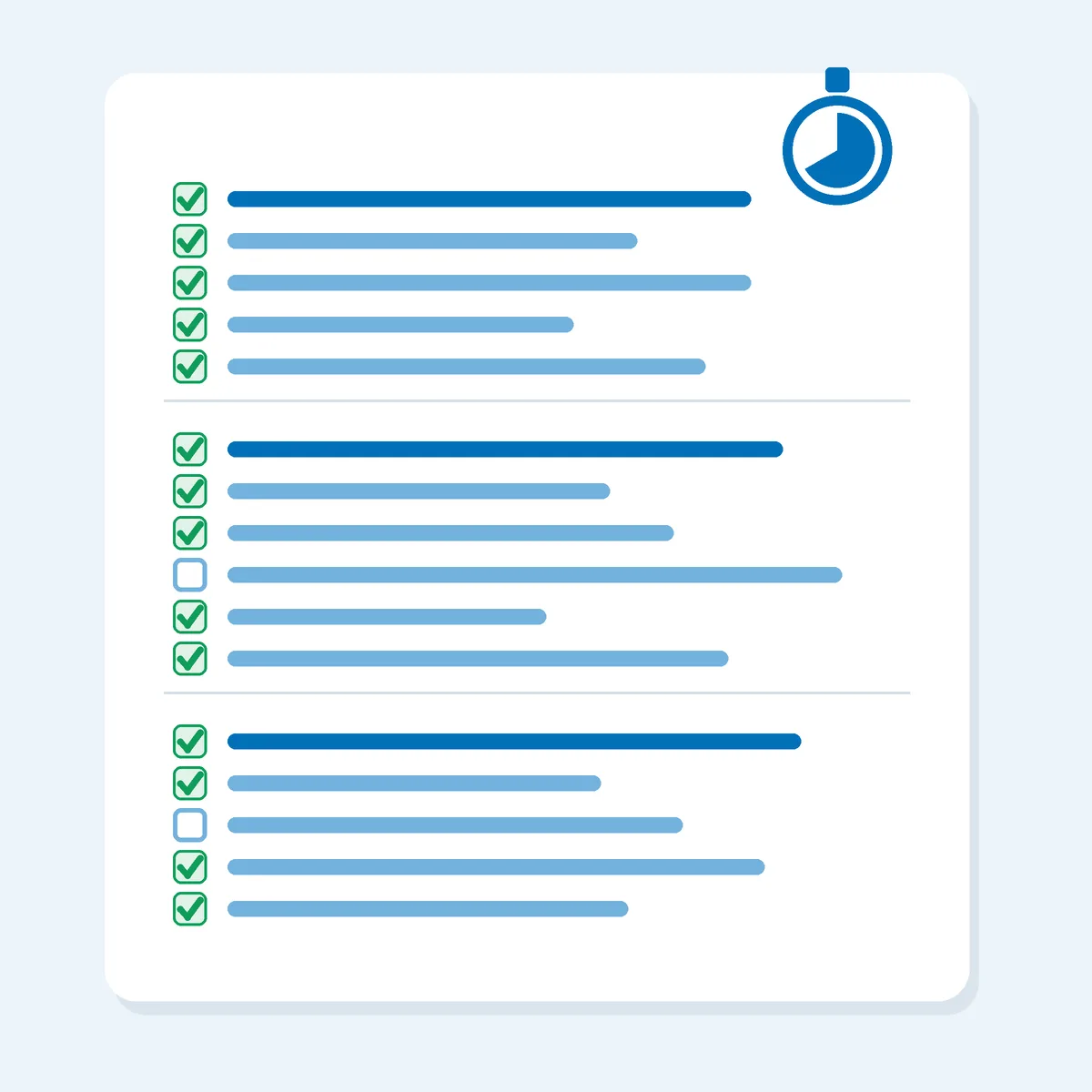
Paste this into your notes and tick it off as you go.
Name (minutes 1 to 3)
- Five candidates written, using your business name, your name plus your service, or your product plus your place.
- Each one passes the radio, length, hyphen, “means something else” and growth tests.
- Quick web search done; no known business in your field already uses it.
- Trademark office database searched for the exact words.
- Top two or three names ranked.
Ending (minutes 4 to 6)
- Decided: .com, a country domain, or both.
- If .ca: you fit a Canadian Presence category and can prove it.
- If .com.au: you have an Australian Presence (for example an ABN) and the name matches your business, trade mark or what you offer.
- If .ie: you have one document showing your connection to the island of Ireland, or evidence of trading with Irish customers.
- If .co.uk, .co.nz or .co.za: you’ve read the registry rules for anything specific to you (for example, .nz needs you to be over 18 or a lawful entity).
- Cayman Islands, Bahamas or BVI ending: rules checked directly with that registry.
Registration (minutes 7 to 10)
- You or your business are the registrant, not a helper.
- Long-term email address on the record.
- Business or personal name spelled exactly as on your documents.
- Auto-renew on; expiry date in your calendar.
- You know a new domain may not move registrars for 60 days.
That’s it. No paid tool needed for any of it.
Your Move
One domain, ten minutes, and the rules checked before you pay. That’s the whole play.
The name you pick today doesn’t have to be the name you keep forever. It has to be clear, legally yours and pointed at something useful. And a domain on its own is just an address. It needs a home to point to, which is where hosting comes in. If you’re weighing that up, our guide to choosing the right hosting for your hustle site walks through what to check.
Every new site gets us closer to our mission of helping 1,000 people turn their side hustles into main hustles by 2028. Yours can be next.
Your domain needs a home. Get your site online with Side Hustle Hosting. Time to crush it.
Where the numbers come from
Registry rules come from the registries and policy bodies themselves, read 22 October 2026. Rules change, so check the current page before you rely on one. Example businesses in this post are invented.
- Verisign, Registry Services Evaluation Request (RSEP 2017038) (.com described as an unrestricted, unsponsored top-level domain), filed with ICANN, 2017. icann.org
- Nominet, Rules of Registration (clause 4.4, Open SLDs .co.uk and .org.uk), Nominet, 2025 (read 22 October 2026). nominet.uk
- CIRA, Canadian Presence Requirements (categories and Registrant Information Validation), CIRA, 2026 (read 22 October 2026). cira.ca
- auDA, .au Domain Administration Rules: Licensing (2.4, eligibility and allocation criteria), auDA, 2026 (read 22 October 2026). auda.org.au
- auDA, Trust it’s local: The .au Australian Presence requirement, auDA, 2026 (read 22 October 2026). auda.org.au
- Domain Name Commission (InternetNZ), Why .nz, DNC, 2026 (read 22 October 2026). dnc.org.nz
- Domain Name Commission (InternetNZ), .nz Rules (2.2, operational rules), DNC, 2026 (read 22 October 2026). dnc.org.nz
- .IE, How to register a .ie domain, .IE (weare.ie), 2026 (read 22 October 2026). weare.ie
- .IE, Registration and Naming in the .IE Namespace, .IE, 2023. weare.ie
- ZADNA, FAQ (Can only South African citizens register .za?), ZADNA, 2026 (read 22 October 2026). zadna.org.za
- ICANN, FAQs for Registrants: Transferring Your Domain Name, ICANN, 2017 (read 22 October 2026). icann.org
- ICANN, Expired Registration Recovery Policy (2.1.1, expiration reminder notices), ICANN, 2024. icann.org
